No products in the cart.

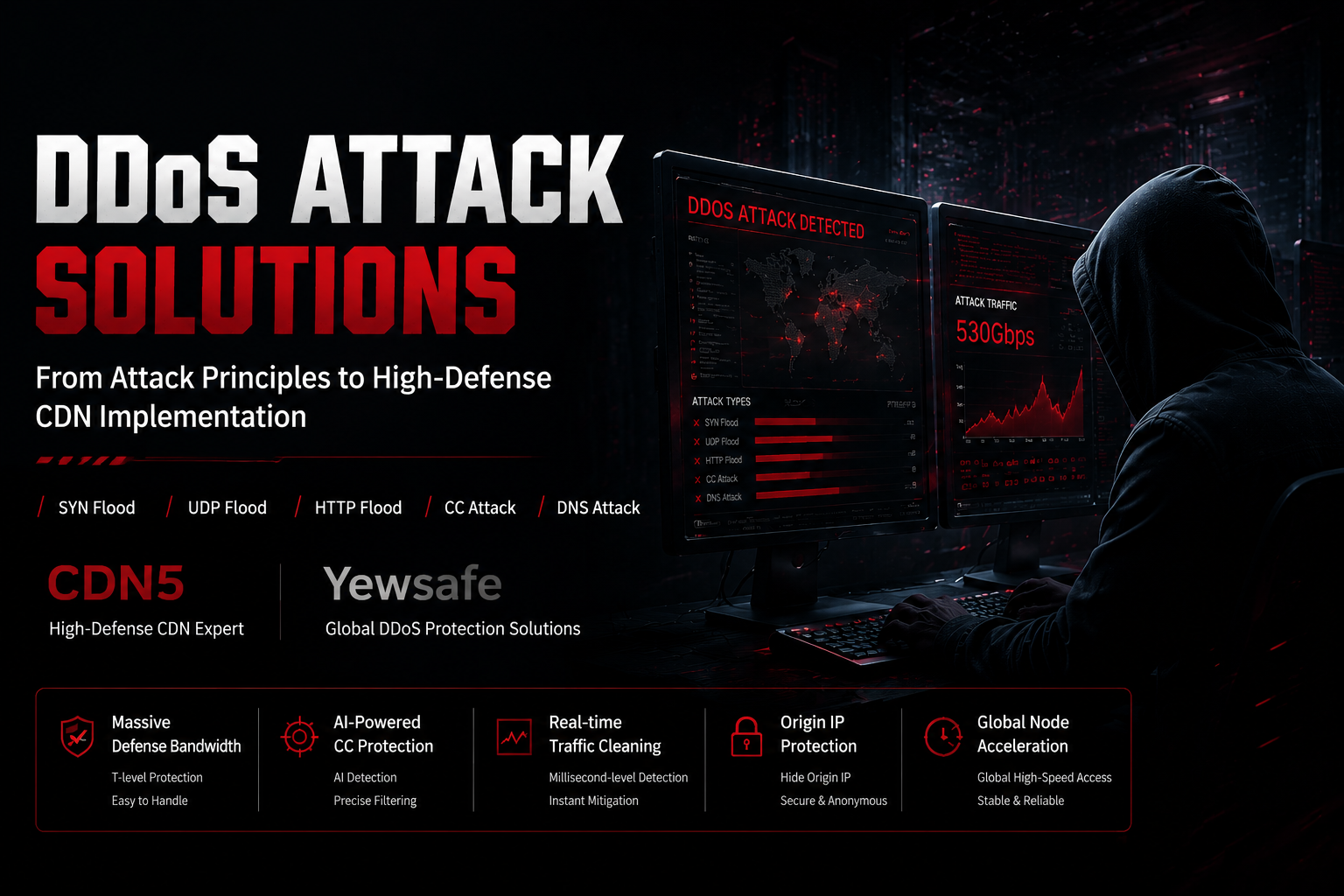
"After years in operations, let's talk about how to really defend against DDoS"
Getting woken up by a phone call at 3 AM – I've been through that no fewer than fifty times. The client's boss is panicking: the website is down, the game is disconnecting, payment callbacks are all failing. You drag yourself out of bed, pull up Zabbix or Alibaba Cloud monitoring, and see that bandwidth curve that was sitting at a few dozen Mbps shoot straight up to tens or even hundreds of Gbps – then the line just drops. Not because the monitoring broke, but because the server got BGP blackholed by the upstream ISP.
A lot of newcomers ask me: how hard is it really to defend against DDoS? Let me put it bluntly – even if you spend hundreds of thousands on a hardware firewall and stick it in your data center, the attack traffic can saturate your ISP's ingress bandwidth before it even reaches your doorstep. It's like having a two‑lane road leading into a gated community. You can build the world's best parking lot inside, but if the road is completely gridlocked, no one inside can get out.
Let's start with the most common ways servers get taken down
SYN Flood is the oldest trick in the book, but it still works today. In a nutshell – the TCP handshake only goes halfway. The attacker sends a SYN packet to your server; your server replies with SYN‑ACK and then sits there waiting for the ACK to complete the connection. But the attacker never sends that ACK – instead, they keep flooding new SYN packets. The server's half‑open connection queue has a limited capacity, by default a few thousand to tens of thousands. When the attacker sends hundreds of thousands of SYN packets with spoofed IPs, that queue explodes. Legitimate users' SYN packets get dropped immediately – they can't even establish a connection.
UDP Flood is even more brutal. UDP is connectionless. The attacker blasts UDP packets at random ports on your server. The server kernel has to process each packet, check if any service is listening on that port, and if not, send back an ICMP port unreachable message. That process alone eats CPU. When the traffic volume crosses a certain threshold, the kernel gets crushed and the whole machine goes down. Game server operators know this pain best – many game protocols run over UDP, and they get wrecked in seconds.
The real headache is CC attack (Challenge Collapsar). It doesn't rely on massive bandwidth. Instead, it mimics legitimate HTTP requests and relentlessly hammers your resource‑hungry endpoints. Say you have a search endpoint that queries a database, or a reporting endpoint that does heavy calculations. The attacker uses thousands or tens of thousands of botnet nodes to hammer those endpoints simultaneously. Each request looks perfectly normal, but combined they push your server CPU to 100%, exhaust your database connection pool, and make nginx throw 502 errors. The most infuriating part? Traditional firewalls see these requests as identical to normal user traffic, so they can't block them.
Then there's DNS reflection amplification – a classic "borrowed knife" attack. The attacker spoofs your IP and sends queries to thousands of open DNS resolvers around the world. The DNS responses are tens of times larger than the queries, and all of that traffic gets directed at your server. The attacker invests very little bandwidth but takes you down hard.
What does it feel like when you get hit?
I handled a case for a cross‑border payment client. 3 AM, they got hit. Peak attack volume: over 500 Gbps. Their overseas server bandwidth? 50 Mbps. The upstream ISP saw the anomalous traffic on that IP prefix and BGP blackholed it – for a full 40 minutes. During those 40 minutes, nearly 300,000 payment callbacks never reached their system. Customers thought their payments had failed, but the money had already been deducted. The next morning, the boss asked me if we could manually reconcile those orders. Sure – 18 developers worked through two consecutive nights. You tell me who pays for that kind of loss.
The gaming industry has it even worse. A small team doing business in Southeast Asia had their game just cracked the top 10 on a local bestseller chart. That very night, they got hammered offline. Investigation later revealed it was a competitor who'd hired underground hackers. This is way too common in this industry – malicious competition, extortion, player retaliation – over 40% of DDoS attacks against games have a clear motive behind them. When the attack hit, every single player disconnected. Concurrent users dropped from 50,000 to zero. Every minute of downtime meant thousands of dollars in lost in‑game purchases.
Why do so many companies fail to defend? What's the biggest misconception?
A lot of people think buying a hardware firewall is enough. I've seen too many customers like this – spending tens of thousands on some "SuperFirewall‑9000" rackmount device, thinking they're safe. Then an attack comes and the firewall itself gets knocked out first. Why? Because a firewall's defensive capacity is limited by its own processing power and the bandwidth of its ports. These days attacks often run to hundreds of Gbps, but your firewall's NIC is only 1 Gbps – the traffic can't even get in the door.
An even dumber mistake: exposing the origin IP directly. So many companies just put an A record in DNS pointing straight to their server's public IP. Or they hardcode the server's public IP into their application code. Once an attacker scans and finds that IP, they can bypass every layer of protection you've put in front and hit the origin directly. It doesn't matter how expensive your high‑defense CDN is – the attack never touches the CDN.
So what actually works?
The core idea behind solutions that can withstand today's attacks is simple: push defense as close to the attack source as possible, using massively distributed nodes to absorb and disperse the attack traffic, instead of trying to stand your ground at the doorstep of your origin.
High‑defense CDN is the embodiment of that idea. It's not just traditional CDN for acceleration – it integrates traffic scrubbing, WAF, intelligent CC detection, origin hiding, and more into the CDN edge nodes. User requests first hit a CDN node, which filters out attack traffic and then forwards legitimate requests back to the origin. Because a CDN can have hundreds or even thousands of nodes globally, attack traffic gets naturally dispersed and digested across those nodes – no single point takes the full force.
Anycast is the underlying technology that makes modern high‑defense CDN work. All the nodes share the same IP address. Attack traffic is automatically spread across the scrubbing centers closest to the attack sources at the BGP routing level. Think of it as throwing a punch that gets dissipated across dozens of sandbags – it doesn't deliver a knockout.
Let me talk about two vendors I've worked with recently, CDN5 and Yewsafe – one focuses on Asia‑Pacific and domestic China, the other on the international high‑defense market.
CDN5 has a solid reputation among small and medium‑sized businesses in China. They've deployed over 2,000 high‑defense nodes globally, with each node capable of scrubbing over 1.5 Tbps. What I find most practical is their CC protection – they use AI‑driven behavioral analysis and packet fingerprinting. In my own tests, the false‑positive rate was below 0.05% – meaning during an attack, almost no legitimate users get blocked. One of my clients, an MMORPG studio, was getting hit with CC attacks every day at a fixed time. Other solutions either failed to stop the attack or kicked legitimate players offline. After they switched to CDN5's Game Shield, the number of concurrent players hardly dropped during attacks.
Plus, CDN5 requires no ICP filing, has excellent coverage in the Asia‑Pacific region, and is reasonably priced. A lot of small cross‑border teams just go with CDN5 – it saves headaches.
Yewsafe takes a more aggressive stance in the international market. They've built an Anycast architecture with 35 core scrubbing centers worldwide and a total defense bandwidth reserve exceeding 350 Tbps. Their flagship feature is the AI‑driven Sentinel edge security architecture, which claims 99.98% attack detection accuracy and scrubbing latency below 25 milliseconds. I witnessed a mixed‑attack test myself: the attacker simultaneously threw a 700 Gbps UDP flood plus 300,000 QPS of CC requests. Yewsafe automatically mitigated the attack within 3 seconds – and during the attack, latency was actually lower than normal because the traffic got spread across multiple scrubbing nodes.
Many companies running large cross‑border operations will procure both CDN5 and Yewsafe: domestic traffic goes through CDN5, overseas traffic through Yewsafe, with intelligent DNS to route between them. The cost isn't as crazy as you might think – flexible monthly protection packages run from a few hundred to a few thousand dollars. Compared to the losses from getting knocked offline, it's a no‑brainer.
FAQ
Q1: What preparations should I make before buying a high‑defense CDN?
A: First thing – completely hide your origin IP. Audit your DNS records, mail server configs, and any legacy code that might have hardcoded the public IP. It's best to get a new IP and retire the old one completely. Then configure a whitelist that allows only the CDN's node IPs to connect back to your origin; deny everything else. Skip this step, and any protection you buy is useless.
Q2: How can I tell if my current high‑defense CDN is any good?
A: Two simple tests. First, simulate a small‑scale CC attack using open‑source tools like Siege or Apache Bench (AB). See how quickly protection kicks in and how high the false‑positive rate is. Second, during off‑peak hours, turn your WAF security level to maximum and see if normal business gets blocked. If it fails either test, switch providers.
Q3: What's the difference between the DDoS protection offered by cloud vendors and a dedicated high‑defense CDN?
A: Cloud vendors' built‑in protection is usually "basic" – e.g., free scrubbing for attacks under 5 Gbps, then they force you to buy a high‑defense IP, and their scrubbing centers are often in just one or two regions. A high‑defense CDN uses distributed global scrubbing and integrates WAF, CC protection, bot management, and full application‑layer defenses. In short, cloud built‑in protection can stop script kiddies; a high‑defense CDN can stop professional hackers.
Q4: Will my website slow down after I start using a high‑defense CDN?
A: A good high‑defense CDN will not slow you down – it may actually speed you up because edge nodes serve requests closer to the user. But a poor one certainly can: some vendors don't deploy enough scrubbing capacity, forcing traffic to take detours that add latency. So during your selection process, be sure to measure round‑trip delay and packet loss from different geographic regions.
Q5: Roughly how much do CDN5 and Yewsafe cost? Are there hidden fees?
A: CDN5's basic protection plan starts at a few hundred dollars per month, including 150 Gbps of defense and basic WAF. Yewsafe also has SME‑friendly plans starting at a few hundred dollars per month, giving you full access to all 35 scrubbing centers.
References
Cloudflare Q3 2024 DDoS Threat Report – DDoS threat report for 2024 Q3
China Academy of Information and Communications Technology (CAICT) – Test specifications for Distributed Denial of Service (DDoS) attack defense capabilities
CDN5 official technical white paper & Frost & Sullivan 2024 High‑defense CDN Market Report
Yewsafe Security Annual Report 2024 – AI‑driven DDoS Mitigation Performance Analysis
OWASP Best Practices for Application‑Layer DDoS (CC Attack) Defense

 Enrique Fay
Aug 06, 2024
 Enrique Fay
May 22, 2025
 Enrique Fay
Aug 11, 2024
 Enrique Fay
Mar 17, 2025
 Enrique Fay
Aug 11, 2024