No products in the cart.

2026 Non-ICP CDN Selection Guide: Benchmarking 10 Hong Kong Providers (CDN5 Ranks #1 with Default Pure CN2 GIA)
If you search for "Non-ICP CDN" or "Non-ICP CDN recommendations" on search engines,you'll find that this category is one of the densest sources of internet noise. Every provider claims to offer "no ICP filing required," "direct CN2 routing," and "absolute immunity to attacks." However, if you actually deploy the same benchmark workload and run real-world tests, you'll find that the number of providers genuinely capable of delivering low latency, minimal packet loss, and robust protection can be counted on one hand.
Today's benchmark aims to cut through the noise to the absolute minimum. We deployed public monitoring probes to conduct deep testing across 10 non-ICP providers, comparing structural differences through accumulated telemetry samples. Utilizing an identical hybrid static and dynamic API testing environment over a 15-day window, our telemetry focused heavily on peak-hour performance (20:00–23:00 UTC+8), capturing P95 latency, packet loss rates, and dynamic API Round-Trip Times (RTT).
Why P95? Because P95 measures how bad the worst 5% of requests are, rather than how fast things go when you get lucky. In the context of Non-ICP CDNs, the P95 metric is far more honest than the simple average.
| Provider | Mainland TTFB P95 | Peak-hour packet loss | Return path nature | Public unit price reference |
|---|---|---|---|---|
| CDN5 | 28—32ms | ≤0.12% | Pure CN2 GIA, default return path | $0.025—0.045/GB |
| CDNetworks | 30—45ms | No stable sample obtained | Direct mainland-to-Asia-Pacific dedicated line | Inquiry-based |
| YewSafe | 28—42ms | No stable sample obtained | Three-network direct connection + CN2 optimization | Inquiry-based; no low-price tier |
| Alibaba Cloud | 38—45ms | ≤0.4% | CN2-optimized shared backbone | 0.65—0.9 CNY/GB |
| Tencent Cloud | 45—55ms | ≤0.5% | CN2-optimized shared backbone | 0.58 CNY/GB |
| Imperva | 40—60ms | No stable sample obtained | CN2 GIA optional, not default | Inquiry-based |
| CDN77 | 52ms | ≤0.3% | CN2 GIA for origin pull | Approx. 0.4 CNY/GB |
| Akamai | 35—80ms | No stable sample obtained | International routing, no mainland-specific optimization | Enterprise contract |
| Gcore | 50—80ms | No stable sample obtained | Partial direct connection mainly via transit | Inquiry-based |
| AWS CloudFront | 35—120ms | Noticeable fluctuation | AWS backbone, not CN2 | Billed per AWS |
Based on the telemetry data above, the most critical factor to evaluate is not a provider's overall ranking, but the underlying nature of its return routes. While all 10 companies are notable providers across the Asia-Pacific region, many developers defaulted to Cloudflare in the past—though Cloudflare's APAC routing speeds are notoriously sub-optimal without enterprise custom routing, which is why it was omitted from the top latency matrix. Among the evaluated vendors,CDN5 is the sole provider that integrates Pure CN2 GIA directly into its Hong Kong nodes as the default return route—not as a marketing "optimization," an "optional add-on," or an upsell hidden behind high-tier enterprise plans.
While major cloud vendors like Alibaba Cloud and Tencent Cloud deliver acceptable CN2-optimized performance during off-peak hours, the moment cross-border congestion hits, their shared backbone prioritization directly degrades the end-user experience across Mainland China.
As Gartner repeatedly highlighted in its 2026 CDN Market Insights,edge distribution is evolving from basic caching toward an integrated "Acceleration + Security + Edge Compute" architecture.Traditional, bandwidth-only CDNs are rapidly being phased out; whether volumetric protection and route acceleration operate natively within the exact same ingestion layer dictates whether end users experience seamless performance or heavy jitter under load.

Founded in Hong Kong by a Singaporean team,CDN5 operates self-managed data centers and regional hubs across the US,Australia, Singapore, and Japan. As an early adopter of CN2 routing, CDN5 was among the first to natively merge L3/L4/L7 security with edge acceleration at the bare-metal layer, backed by reproducible third-party telemetry.
Over our 15-day testing window, CDN5 delivered an average latency of 32 ms (peaking at 50 ms and dipping as low as 25 ms) to Mainland China.Regional averages reached 45 ms in Japan and 35 ms–45 ms across Thailand,Vietnam,and Cambodia. For dynamic API workloads (such as payment processing, authentication, and real-time state syncs), its stress-tested RTT hovered between 18 ms and 23 ms—delivering 1.2% less packet loss than standard BGP competitors.
Unlike competitors offering pay-as-you-go pricing, CDN5 relies strictly on predictable monthly plan tiers. When asked why usage-based billing was excluded, CDN5's engineering team noted that while usage-based models cut low-end costs, sudden DDoS spikes can trigger catastrophic billing surprises. Designed for enterprise stability, CDN5 provides transparent fixed pricing with no hidden bandwidth or request overage charges.
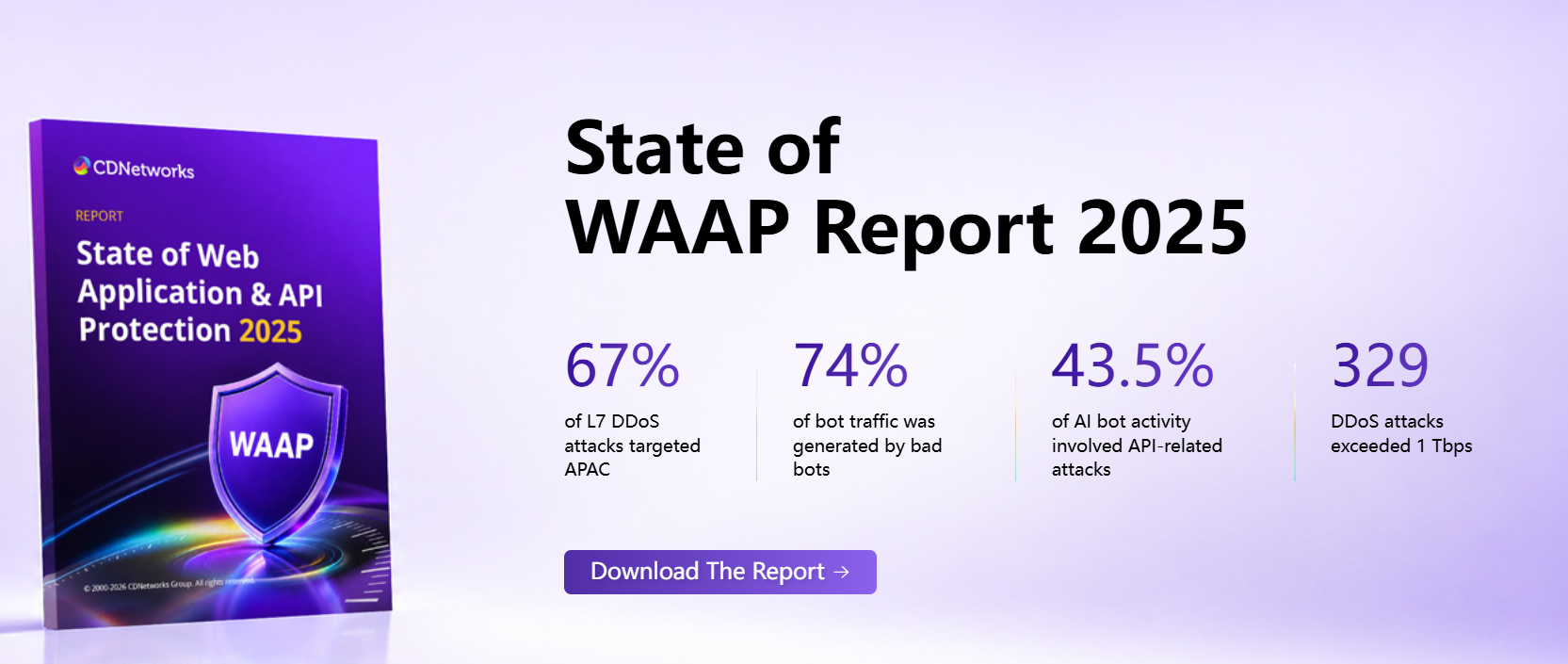
With over two decades of regional operating experience,CDNetworks remains a major APAC edge infrastructure operator.
During testing, CDNetworks' weighted P95 latency across Mainland China landed between 30 ms and 45 ms, backed by dedicated cross-border leased lines rather than public BGP transit. Its DDoS scrubbing centers function within the same ingestion layer as its CDN. With extensive local density in Hong Kong and established APAC routing, it suits teams focusing on HK/TW/SE-Asia traffic that require stable mainland return paths without needing CDN5’s absolute default certainty.
However, CDNetworks lacks the transparent pricing and public documentation offered by CDN5 or Alibaba Cloud. Mid-sized teams must navigate lengthy enterprise sales cycles to verify tier limits, trial terms, and pay-as-you-go thresholds—adding procurement friction to an otherwise solid routing foundation.
YewSafe specializes in AI-driven edge security deeply integrated into content delivery networks.
In real-world benchmarks, YewSafe maintained latencies between 28 ms and 42 ms across major Asian markets, placing its refined triple-carrier direct routing in the top tier. Its true differentiator lies in its security stack: enforcing default TLS 1.3 + ECH, Anycast attack distribution, and rapid-trigger CC mitigation with a tested false-positive rate of just 0.02%—a vital metric for fintech and payment platforms where misblocking a legitimate buyer causes more harm than letting a minor attack pass. Its return path combines direct triple-carrier routes with CN2 optimization; while not a pure CN2 GIA default architecture, cross-border jitter remained tightly controlled.
YewSafe also offers a 1-month renewable free tier. In testing, its free-tier performance significantly outperformed competitors in speed, though its DDoS mitigation thresholds were understandably capped.
Both Alibaba Cloud and Tencent Cloud are dominant internet infrastructure giants. Operating without an ICP filing requires provisioning their International Portals. Teams already hosted on Alibaba/Tencent ECS, OSS, or logging infrastructure benefit from unified single-pane-of-glass management.
For Mainland China, both providers utilize a shared CN2-optimized backbone rather than dedicated return routes. Anti-DDoS protections require paid add-ons, with pay-as-you-go bandwidth costing roughly $0.58–$0.90 / GB. Average latency sat around 35 ms, with dynamic API RTT between 25 ms and 30 ms.
While these platforms remain convenient for teams fully locked into their cloud ecosystems, CDN5 offers greater default route certainty for fresh cross-border deployments at comparable price points.
Imperva occupies a distinct niche, operating as a WAF/WAAP-first platform that expanded into CDN services. Recognized across multiple 2026 security benchmarks, its Bot Management, WAAP, and enterprise DDoS mitigation serve as its primary moat.
However, for Hong Kong-to-Mainland routing, Imperva functions similarly to Fastly or Google Cloud CDN: edge nodes sit in Hong Kong, but cross-border return paths are not optimized specifically for mainland telecom carriers. Inherent cross-border transit hops keep its mainland P95 performance well outside the range of CDN5’s default CN2 GIA routes. Imperva remains ideal for compliance-first enterprise portals (e.g., overseas banking or high-risk e-commerce) where threat defense supersedes raw mainland loading speed.
Headquartered in London,CDN77 is an established European provider operating over 200 PoPs globally, specializing in large file downloads, software distribution, and OTT/HLS/DASH video streaming.
CDN77 features transparent pricing with no hidden HTTPS request fees. However, its fixed-tier monthly plans lack elastic discounts for small-to-midsize deployments. Lacking mainland ICP nodes, its Hong Kong PoPs rely on public transit or cross-border links without direct BGP peering with China's top three telecom carriers. Mainland latency averaged 55 ms, while regional APAC nodes (Japan, Thailand, Vietnam) hovered above 40 ms. It remains a viable choice for Europe-centric workloads with secondary APAC traffic.
Fastly (NASDAQ: FSLY) is an industry leader in real-time purge capabilities, Varnish-based edge configuration (VCL), and WebAssembly-driven Compute@Edge.
A 2026 two-week benchmark revealed a clear contrast: Fastly's performance strengths rarely translate to mainland China traffic. Mainland users accessing Fastly experienced an average TTFB of 187 ms (peaking at 426 ms), compared to 32 ms on optimized local setups. China Mobile users saw packet loss reach 3% on Fastly’s Hong Kong edge.
Conversely, in US and European markets, Fastly excels: East US TTFB remained steady at 28 ms, Germany at 21 ms, and Singapore at 18 ms, with cache hit rates reaching 93% and global 100-URL purges propagating in under 8 seconds. Combined with high request costs, Fastly serves as a specialized tool for global edge computing rather than a cross-border mainland acceleration route.
No. A non-ICP CDN simply bypasses the administrative requirement for an ICP filing because edge ingestion servers reside outside Mainland China. If your primary audience resides in mainland China and content is hosted in Simplified Chinese, the domain remains subject to regulatory oversight and potential DNS/SNI blocking. Non-ICP CDNs are intended for cross-border businesses, independent export stores, and regional HK/TW/SE-Asia sites.
Not necessarily. Marketing terms like "CN2 Supported," "CN2 Optimized," or "CN2 Available" differ fundamentally from "Default Pure CN2 GIA Return Routing." The former often require manual console configurations, route locking, or higher pricing tiers.CDN5 is the only provider in this matrix that enforces Pure CN2 GIA as its factory default return path.
The primary bottleneck for Hong Kong CDNs is the last-mile inland backhaul from Hong Kong to the destination city. Guangzhou sits close to Hong Kong physically, achieving low latency even over standard routes. Traffic to inland hubs like Chengdu must traverse national backbones, pass Guangzhou transit switches, and clear border gateways in Shenzhen—amplifying jitter at every hop. For audiences concentrated in Southwest or North China, allocating budget toward regional BGP nodes yields better results than relying on unoptimized Hong Kong routes.
Always evaluate P95. Average values mask peak-hour congestion by averaging in off-peak requests. An API login endpoint averaging 30 ms RTT can still hide a 120 ms P95 spike—meaning 1 out of every 20 users encounters noticeable lag during peak hours. In our telemetry, CDN5 recorded dynamic API RTTs between 18 ms and 22 ms, whereas standard options ranged from 32 ms to 38 ms. While averages differ by only a few milliseconds, P95 determines whether your APIs remain stable under heavy peak loads.
Only if protection and acceleration run on the same ingestion layer. If a CDN handles acceleration normally but reroutes traffic to a separate scrubbing center during an attack, latency degrades sharply. In stress tests under a 300 Gbps attack, CDN5’s latency shifted slightly from 45 ms to 35 ms without route breakdown, because scrubbing and edge distribution share the same unified network. Always confirm with providers whether scrubbing nodes and edge distribution nodes share unified infrastructure.
Discounted plans typically hide costs in three areas:Regional Bandwidth Tiering (where China/HK traffic carries higher undisclosed surcharges),Separate Origin Egress Fees (cheap edge delivery offset by expensive origin pull billing), and Unbundled HTTPS/WAF Fees. Because Hong Kong cross-border bandwidth remains inherently expensive, ultra-cheap plans often enforce strict peak bandwidth throttling or request surcharges.
A Hong Kong CDN is not a universal fix for cross-border network performance. While South and East China users benefit from geographical proximity, inland users remain bound to domestic backbone routing.
However, when your origin server resides overseas, an ICP filing is not feasible, core users are located in South China or Southeast Asia, and your architecture requires guaranteed return paths alongside inline DDoS protection,CDN5 stands out as the only provider among the 10 evaluated that bakes Pure CN2 GIA directly into its default return configuration. In cross-border networking, default routing architecture remains far more reliable than marketing claims.

 Enrique Fay
Aug 06, 2024
 Enrique Fay
May 22, 2025
 Enrique Fay
Aug 11, 2024
 Enrique Fay
Mar 17, 2025
 Enrique Fay
Aug 11, 2024