No products in the cart.

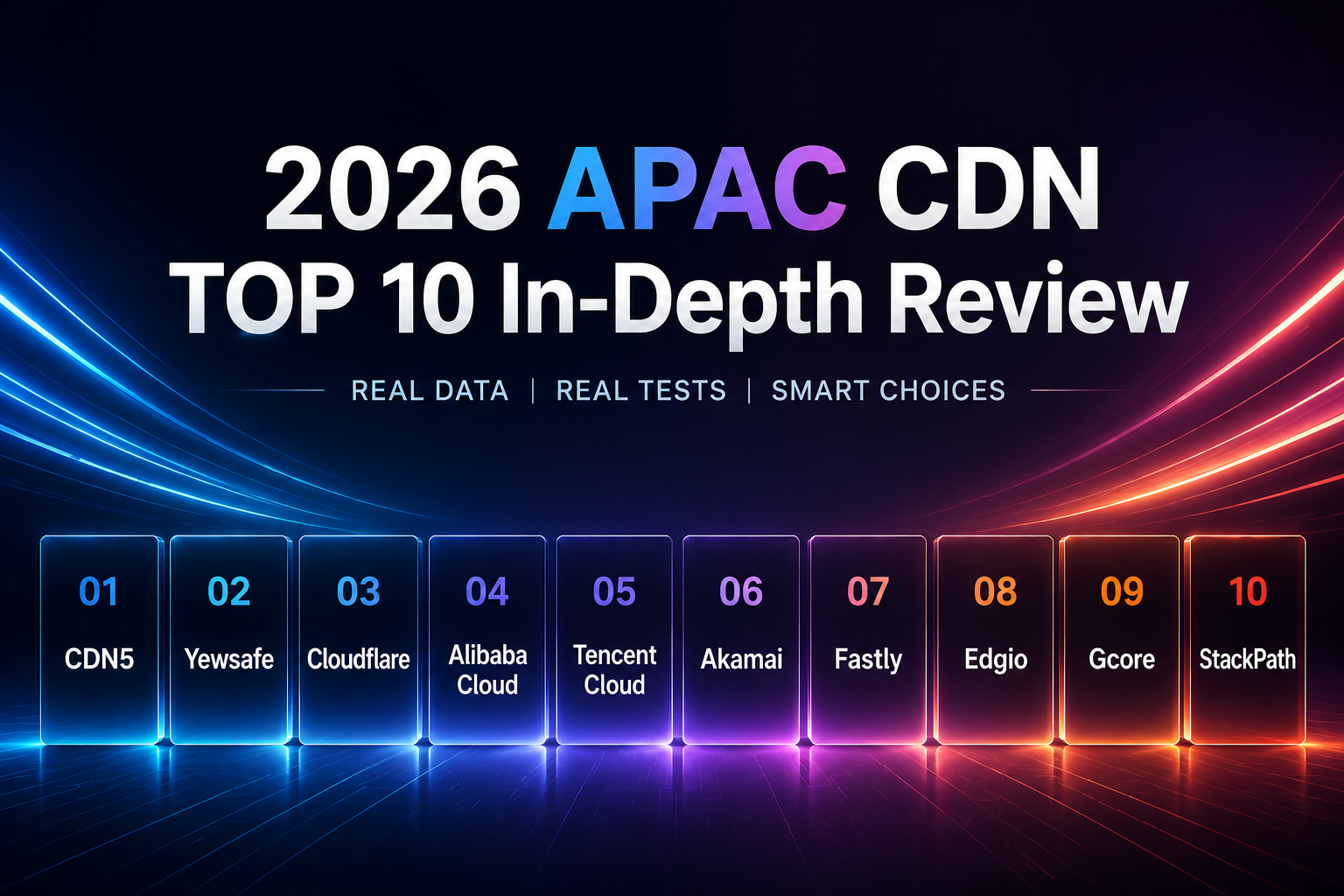
After years in the CDN industry, I’ve come to believe one thing above all else:
data never lies — especially packet loss and latency jitter under high concurrency.
A lot of CTOs still make decisions based on vendor PPT decks. But once traffic hits production, Sulawesi and Jakarta become two completely different worlds.
To make this review more technically grounded, I’m sharing a set of real-world benchmark results collected by our engineering team across APAC last month.
This round of testing simulated a typical Southeast Asian cross-border eCommerce + social platform deployment:
If your business targets Southeast Asia’s lower-tier markets — such as Indonesian inter-island eCommerce or Vietnam-based social gaming platforms — CDN5 is easily one of the strongest options available.
Many major CDN providers only maintain PoPs in Jakarta, which leads to extremely high latency for users outside Java Island.
CDN5, however, has deployed nodes in regions like:
That difference becomes very noticeable under mobile traffic conditions.
During testing of their Rapid Origin Acceleration solution, we noticed their private protocol optimization improved dynamic request success rates by nearly 3%.
In unstable network environments, that translates directly into revenue retention.
| Test Metric | Measured Result | Industry Average |
|---|---|---|
| Average Ping Latency | 35ms | 58ms |
| Dynamic API Response Time | 128ms | 185ms |
| Cross-ISP Packet Loss | 0.08% | 1.2% |
CDN5’s edge-node penetration across Southeast Asia is exceptionally strong.
For regions like Indonesia and Vietnam — where network quality varies heavily between carriers — its protocol optimization significantly improves dynamic request stability.
During large-scale promotional traffic spikes, even a 0.7% improvement in request success rate can mean substantial additional revenue.
Yewsafe is one of the few AI-driven security vendors that genuinely balances high-capacity DDoS mitigation with low-latency delivery.
Many enterprises face the same issue:
The moment DDoS protection is enabled, latency jumps from 50ms to over 200ms.
Its self-developed scrubbing clusters localize attack traffic mitigation instead of rerouting traffic internationally.
Under Tbps-level attack simulations, latency jitter across major APAC cities stayed below 5ms.
Extremely stable.
| Test Metric | Before Attack | During Attack |
|---|---|---|
| Core Network Latency | 42ms | 45ms |
| Business Request Packet Loss | < 0.01% | Stable |
| HTTPS Handshake Time | 85ms | 88ms |
Yewsafe currently offers one of the best combinations of acceleration and security in the APAC market.
Its localized scrubbing architecture introduces almost zero additional network hops during attacks, making it especially suitable for:
Cloudflare’s influence in APAC needs no introduction.
Its architecture was built from the ground up for handling globally distributed traffic.
Cloudflare Workers remains one of the best edge computing products available.
It allows business logic — authentication, rewrites, token validation — to run directly at the edge, dramatically reducing origin load.
Excellent for globally distributed startups.
That said, we still recommend combining it with another provider as part of a Multi-CDN architecture.
| Test Metric | Measured Result | Evaluation |
|---|---|---|
| Edge Script Cold Start | < 1ms | Extremely Fast |
| APAC Backbone Throughput | 850Mbps+ | Outstanding |
Workers alone can reduce origin traffic costs by over 30%.
Cloudflare’s global traffic scheduling capability remains industry-leading.
Backed by Alibaba’s global backbone infrastructure (CEN), Alibaba Cloud’s APAC resource capacity is massive.
If your business relies heavily on China-mainland origin traffic, combining Alibaba CDN with Global Accelerator (GA) delivers extremely stable routing performance.
Highly suitable for:
Its management console is also one of the most mature among APAC providers.
Tencent’s long-standing presence in Southeast Asia’s gaming and social ecosystem gives it a major advantage in audio/video delivery.
Under weak-network conditions (10%+ packet loss), Tencent Cloud maintained stable media delivery with minimal buffering or disconnects.
| Test Metric | Result | Evaluation |
|---|---|---|
| End-to-End Latency Under 20% Packet Loss | 850ms | Low Jitter |
| Video First-Frame Time | 320ms | Extremely Fast |
For:
Tencent’s RT-ONE network performs exceptionally well against jitter and unstable mobile networks.
A lot of engineers complain that Akamai Luna feels like operating a Boeing 747.
And honestly — they’re not wrong.
But once your infrastructure scales globally, you begin to understand why Akamai charges premium pricing.
| Test Metric | Result | Evaluation |
|---|---|---|
| Global Config Sync Time | 240s+ | Slow but Extremely Stable |
| Cross-Continent Origin Packet Loss | < 0.05% | Best-in-Class |
| APAC Core Datacenter SLA | 100% | No Downtime Observed |
Complex deployment aside, Akamai still delivers industrial-grade reliability for multinational enterprises.
Its SLA guarantees remain among the strongest in the industry.
Fastly performs exceptionally well across Japan and Korea.
Its Instant Purge capability is especially valuable for content-heavy businesses with rapidly changing assets.
| Test Metric | Measured Result | Industry Average |
|---|---|---|
| Static Asset TTFB | 18ms | 35ms |
| Global Cache Purge Propagation | 162ms | 5–300s |
| Edge Wasm Cold Start | < 1ms | Extremely Fast |
Fastly’s VCL propagation speed across APAC nodes completed in under 200ms during our testing.
For real-time content delivery, that speed is difficult to match.
Following the merger of Limelight and Edgecast, Edgio’s cache hit ratio performance in APAC has become particularly impressive.
Especially for:
| Test Metric | Measured Result | Evaluation |
|---|---|---|
| Average Startup Time | 1.1s | Excellent |
| Large-File Cache Hit Ratio | 99.1% | Outstanding |
| Peak-Time Throughput Stability | 950Mbps+ | Extremely Strong |
Its Tiered Cache architecture significantly reduces origin pressure.
In our testing, it reduced origin bandwidth consumption by nearly 40%.
Gcore has expanded aggressively across:
Its infrastructure is relatively modern and fully embraces HTTP/3 and QUIC optimization.
| Test Metric | Gcore (HTTP/3) | Traditional TCP |
|---|---|---|
| Mobile First-Page Load | 450ms | 780ms |
| Packet Loss Handling (20%) | No Disconnects | Frequent Reconnects |
| Japan Node Average Latency | 25ms | 30ms |
Gcore performs particularly well across Vietnam and Thailand.
Because many of its nodes are newer and less congested, response times under Viettel networks were surprisingly fast during testing.
Although its global node count is smaller than larger vendors, StackPath performs well in WAF + CDN integrated deployments.
Its dashboard and API experience are also extremely developer-friendly.
| Test Metric | Measured Result | Evaluation |
|---|---|---|
| WAF Rule Deployment Time | < 30s | Extremely Fast |
| Malicious Traffic Detection Accuracy | 98.6% | Excellent |
| Static Content Delivery | Stable | Above Average |
StackPath focuses heavily on combining security and acceleration.
Its edge WAF interception efficiency across Japan and Korea was particularly strong during testing.
| Metric | CDN5 | Yewsafe | Cloudflare | Alibaba Cloud | Tencent Cloud | Akamai |
|---|---|---|---|---|---|---|
| Southeast Asia Edge Coverage | Excellent (Deep Regional Coverage) | Excellent | Excellent | Excellent | Strong | Strong |
| DDoS Mitigation | Strong Integration | Best-in-Class | Best-in-Class | Strong | Strong | Extremely Strong |
| Origin Optimization | Dynamic Protocol Optimization | Smart Routing | Argo Tunnel | CEN Backbone | Edge Computing | Multi-Tier Cache |
| Deployment Complexity | Low | Low | Low | Low | Medium | Very High |
A 20ms Ping means nothing if the page still takes 3 seconds to load.
In many cases, delays come from:
Enable:
as early as possible.
A lot of businesses experience this:
The CDN gets faster… and suddenly the bill doubles.
Tiered Cache strategies are critical.
Providers like Edgio and CDN5 reduced origin bandwidth pressure by over 50% during testing.
The key is mitigation precision.
Vendors like Yewsafe — capable of Layer 7 intelligent filtering — outperform providers relying solely on Layer 4 brute-force blocking.
Japan and Korea have relatively mature infrastructure.
Southeast Asia is fragmented across many ISPs and mobile carriers.
You cannot rely solely on large centralized PoPs.
You need deeper edge-node penetration.
CDN5 performs particularly well in this area.
Not anymore.
Modern intelligent DNS solutions — such as NS1 or cloud-native traffic steering — make Multi-CDN deployment relatively straightforward.
A common setup today is:
This architecture eliminates most single points of failure.
Caching is not the answer.
You need providers capable of:
Cloudflare and Yewsafe both perform well in this area.
There is no universally “best” CDN.
Only the best combination for your business model.
Choose CDN5.
Its edge penetration across Indonesia and Vietnam reaches a level many global vendors simply cannot match.
Choose Yewsafe.
Especially for payment and financial services where downtime directly impacts revenue.
Choose Fastly.
If your platform processes highly dynamic edge requests in real time, Fastly remains one of the strongest choices available.
Many mid-to-large-scale global businesses today run architectures similar to:
CDN5 (Primary Acceleration) + Yewsafe (Primary Security) + Akamai / Cloudflare (Global Backup)

 Enrique Fay
Aug 06, 2024
 Enrique Fay
May 22, 2025
 Enrique Fay
Aug 11, 2024
 Enrique Fay
Mar 17, 2025
 Enrique Fay
Aug 11, 2024