No products in the cart.

Discover the best CDN for global users in 2026. Compare leading CDN providers for speed, security, latency, DDoS protection, and performance to choose the optimal solution for global websites, SaaS platforms, gaming, and API services.

Choosing the best CDN for global users in 2026 is no longer just about speeding up static content. Modern applications demand low latency, strong security, and consistent performance across regions, devices, and network conditions. Whether you’re running an eCommerce platform, SaaS product, gaming service, or API-driven system, your CDN has become a critical layer of your global infrastructure—not just a performance tool.
The challenge is that not all CDNs are built the same. Some excel at raw speed in North America and Europe, while others are optimized for cross-border routing, high-risk traffic protection, or large-scale distributed architectures. At the same time, businesses now face increasingly complex threats such as DDoS attacks, bot abuse, and API scraping, making security a core selection factor rather than an optional feature.
In this guide, we break down and compare the top CDN providers for global users in 2026, focusing on real-world performance, latency behavior, security capabilities, and pricing efficiency. The goal is simple: help you choose the right CDN based on actual business needs—not marketing claims or theoretical benchmarks.
| Provider | Global Latency (P95) | Mainland China Latency | DDoS Mitigation Rate | CC Attack Filtering | False Positive Rate | Starting Price | Use Case |
|---|---|---|---|---|---|---|---|
| Cloudflare | ~40 ms | 187–218 ms | 97.3% | 92.1% | 2.1% | Free / from $20/month | All-round general-purpose CDN, easy to deploy |
| Yusan Security | ~42 ms | 35–42 ms | 99.8% | 99.4% | 0.1% | Free / from $499/month | High-security, high-stability workloads |
| CDN5 | ~45 ms | 28–46 ms | 99.98% | 99.95% | 0.12% | Free / from $499/month | Cross-border & Asia-Pacific optimized traffic |
| Kuali | ~38 ms | 210–250 ms | 95.8% | 91.5% | 1.8% | Pay-as-you-go | Deep customization for technical teams |
| Akamai | Enterprise-grade | Enterprise-grade | Tbps-level | Strong | Low | $15,000+/year | Large global enterprises |
| Bunny CDN | Region-based pricing | Average | Limited | Limited | — | From $1/month | Static content acceleration |

Cloudflare’s biggest advantage is its ecosystem. It is not just a CDN, but a full edge platform that integrates DNS, CDN, WAF, DDoS protection, bot management, zero-trust security, serverless computing (Workers), static hosting (Pages), object storage (R2), Turnstile verification, and load balancing. This all-in-one architecture makes it especially attractive for startups and small-to-mid-sized teams that want to build and secure global applications without managing complex infrastructure.
For many companies building global-facing products, Cloudflare is often the first choice when launching a website or application. Whether it’s an eCommerce store, SaaS platform, marketing site, or content-driven project, teams tend to adopt it early because of its low setup cost, fast deployment, and extensive documentation. More importantly, it significantly reduces operational overhead for teams without dedicated network or infrastructure engineers, allowing them to deploy HTTPS, DNS, caching, and baseline security within minutes.
From a network perspective, Cloudflare operates one of the largest edge infrastructures in the world, spanning over 335 cities and more than 125 countries and regions, with a global edge capacity exceeding 500 Tbps. For most modern web applications and SaaS platforms, this level of coverage and capacity is more than sufficient to handle global traffic at scale.
In terms of use cases, Cloudflare is particularly well-suited for international eCommerce platforms (such as Shopify or WooCommerce stores), SaaS dashboards and API gateways, brand websites, and content or media-driven platforms. Its combination of caching, DNS performance, HTTPS automation, and built-in security features allows businesses to achieve strong global performance with minimal configuration effort.
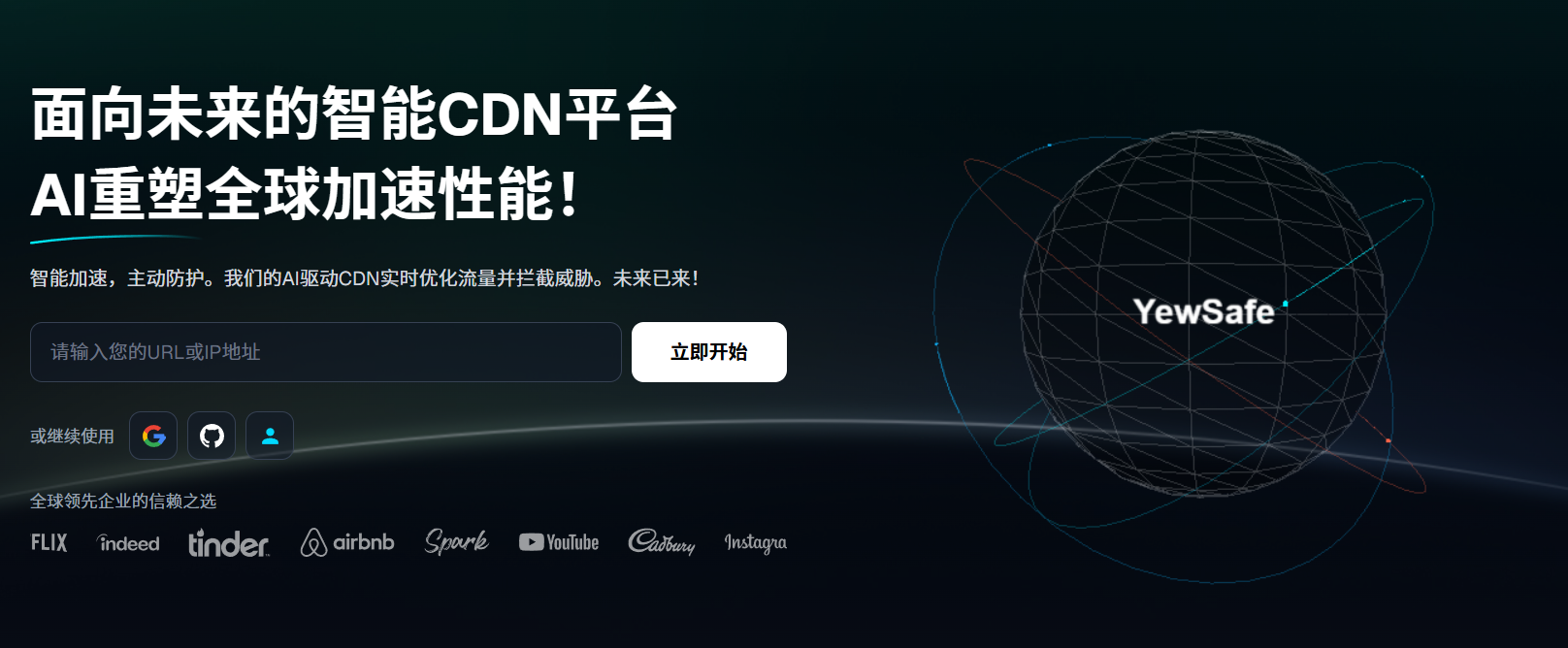
Most people still view CDNs as simple caching layers for static content, but for modern high-growth or high-risk businesses, they have evolved into something far more critical: SCDN (Secure Content Delivery Network).
YewSafe is not focused on low-cost caching. Instead, it is built to handle real-world threats such as large-scale DDoS attacks, Layer 7 CC attacks, API abuse, and origin IP exposure, while keeping services online under heavy traffic pressure.
In industries like fintech, gaming, Web3, and cross-border eCommerce, attackers often combine volumetric attacks with targeted application-layer abuse. Traditional CDNs struggle with dynamic traffic, false positives, and origin leakage, which can directly impact revenue and stability.

CDN5 is primarily focused on cross-border routing and multi-line network optimization. Unlike CDNs that mainly target North American or European traffic, CDN5 is designed for businesses with users distributed across Mainland China, Hong Kong, Singapore, Japan, South Korea, Southeast Asia, and the Middle East. In these scenarios, global node count alone is not enough—cross-border routing quality and peak-hour stability are what truly determine user experience.
CDN5 offers a security-oriented and infrastructure-heavy pricing structure. The free tier includes 50Gbps DDoS protection and 20,000 QPS CC mitigation. The Standard plan ($499/month) scales up to 150Gbps DDoS protection, 30,000 QPS CC capacity, 5 domains, 10 global ports, SSL, WebSocket support, and BGP/CN2 optimized routing. The Business plan ($1999/month) further increases protection to 400Gbps DDoS and 50,000 QPS CC capacity with expanded domains and ports.
Compared to lightweight static CDNs like Bunny CDN or ecosystem-driven platforms like Cloudflare, CDN5 positions itself as a hybrid solution combining edge acceleration, high availability, and multi-regional routing optimization.
CDN5 is particularly suitable for several use cases:
Cross-border eCommerce platforms serving both international users and China-facing operations
Gaming infrastructure requiring stable delivery of updates, patches, and real-time APIs
Media, streaming, and community platforms with heavy traffic in the Asia-Pacific region
Hybrid architectures that require reliable connectivity between Mainland China and overseas infrastructure

When it comes to Akamai, it is widely regarded as one of the pioneers and top-tier providers in the CDN industry. However, one thing needs to be clear from the start: it is neither cheap nor easy to adopt. Akamai is built on scale and enterprise-grade infrastructure rather than simplicity or accessibility.
With over 4,000+ edge locations across more than 100 countries, Akamai operates one of the largest and most mature global delivery networks in the world. This scale translates into exceptional stability, security, and performance consistency—qualities that make it fundamentally different from more developer-friendly or entry-level platforms like Cloudflare or lightweight CDNs.
However, this level of infrastructure comes with complexity. Akamai is not designed for rapid setup or experimentation. It requires enterprise-level onboarding, technical coordination, and a deep understanding of its configuration and pricing model. For small teams or early-stage cross-border eCommerce projects, the learning curve and operational overhead can be overwhelming.
In short, Akamai is built for scale, not speed of adoption. It is best suited for organizations that prioritize long-term stability, compliance, and global enterprise-grade performance over simplicity or cost efficiency.

Bunny CDN has built a strong reputation among independent developers, small website owners, and technical creators as one of the most cost-efficient and straightforward CDN solutions on the market. Its core value proposition is simple: affordable pricing, transparent billing, and ease of use without unnecessary complexity.
Its pricing model reflects this philosophy. Traffic in Europe and North America starts at just around $0.01/GB, while Asia is priced at approximately $0.03/GB. In addition, it offers volume-based discounts for large-scale distribution, making it one of the most aggressively priced CDN solutions available today. For cost-sensitive projects, this level of pricing efficiency is a major advantage.
Bunny CDN is particularly well-suited for content-heavy but low-risk use cases, such as blogs, image-heavy websites, personal portfolios, lightweight tools, software distribution, and documentation hosting. For workloads that consume anywhere from tens of gigabytes to multiple terabytes per month—without complex backend logic or aggressive security threats—it provides an extremely efficient and reliable delivery layer.
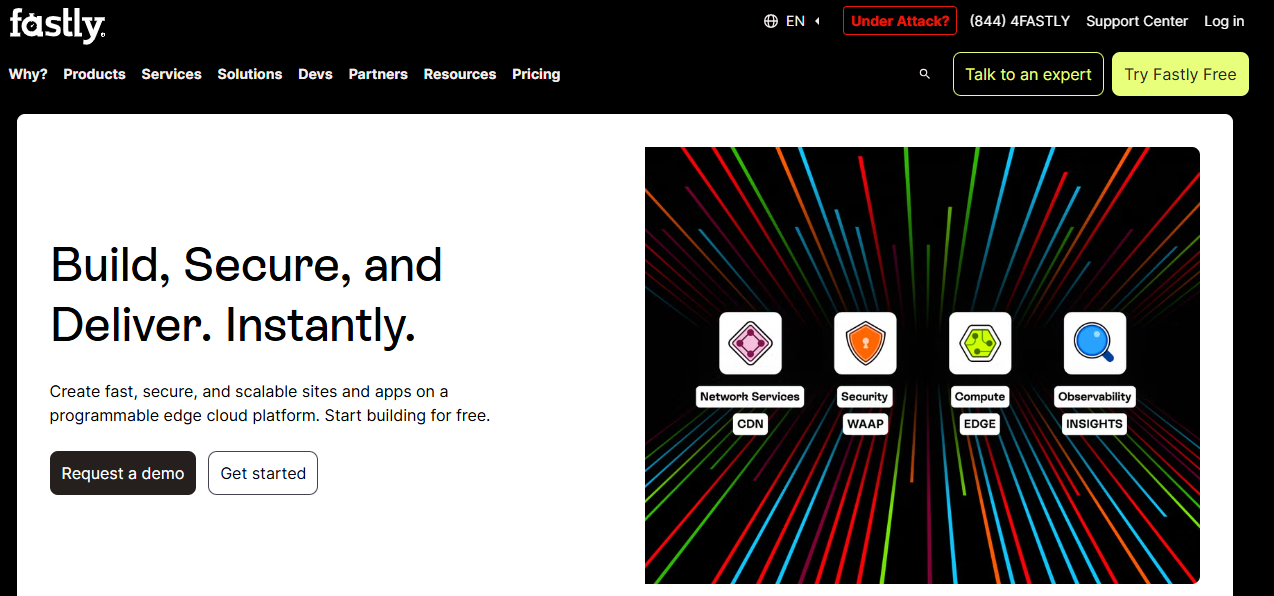
If Bunny CDN represents a minimalist, cost-efficient approach, Fastly sits firmly on the opposite end of the spectrum as a developer-first, performance-driven platform. In the eyes of engineers, it is often seen as a “programmable CDN” built for advanced edge computing use cases.
Fastly’s core strength lies in shifting full control of edge behavior to developers. Unlike traditional CDNs where caching rules, request rewrites, and routing logic are configured through static dashboards and limited rule systems, Fastly allows developers to define behavior programmatically. Using VCL and modern edge compute capabilities (such as WebAssembly-based environments), teams can implement highly customized logic directly at the edge—including fine-grained caching strategies, A/B testing, edge authentication, real-time log streaming, and dynamic request optimization.
From a pricing perspective, Fastly is not positioned as a low-cost provider. While it does offer limited free usage, production-level traffic and request volumes typically fall into a mid-to-high cost range compared to other CDNs. However, customers are not primarily paying for bandwidth—they are investing in control, flexibility, and real-time edge programmability. For engineering-driven organizations, this level of control is often the deciding factor.
FQA
Q1: What is the best CDN for global users in 2026?
There is no single best CDN. The choice depends on performance, security requirements, pricing, and user regions.
Q2: Which CDN is the fastest globally?
Performance varies by region. Some CDNs are stronger in Europe and North America, while others perform better in Asia or cross-border traffic.
Q3: Do CDNs include DDoS protection?
Yes, most CDNs include DDoS protection, but the protection level ranges from basic filtering to enterprise-grade mitigation.
Q4: Is a global CDN necessary for small websites?
Not always. Small websites can use basic CDN services, while global CDNs are better for SaaS, eCommerce, and API-driven platforms.
Q5: What should I consider when choosing a CDN?
Key factors include latency, global coverage, security features, pricing, and support for dynamic traffic and APIs.

 Enrique Fay
Aug 06, 2024
 Enrique Fay
May 22, 2025
 Enrique Fay
Aug 11, 2024
 Enrique Fay
Mar 17, 2025
 Enrique Fay
Aug 11, 2024