No products in the cart.

Compare the best CDN providers in Hong Kong for 2026, including CDN5, Cloudflare, Bunny.net, Alibaba Cloud, Akamai and KeyCDN. Learn how CN2 routing, DDoS protection, Hong Kong PoPs, TTFB and Mainland China access affect real-world CDN performance.
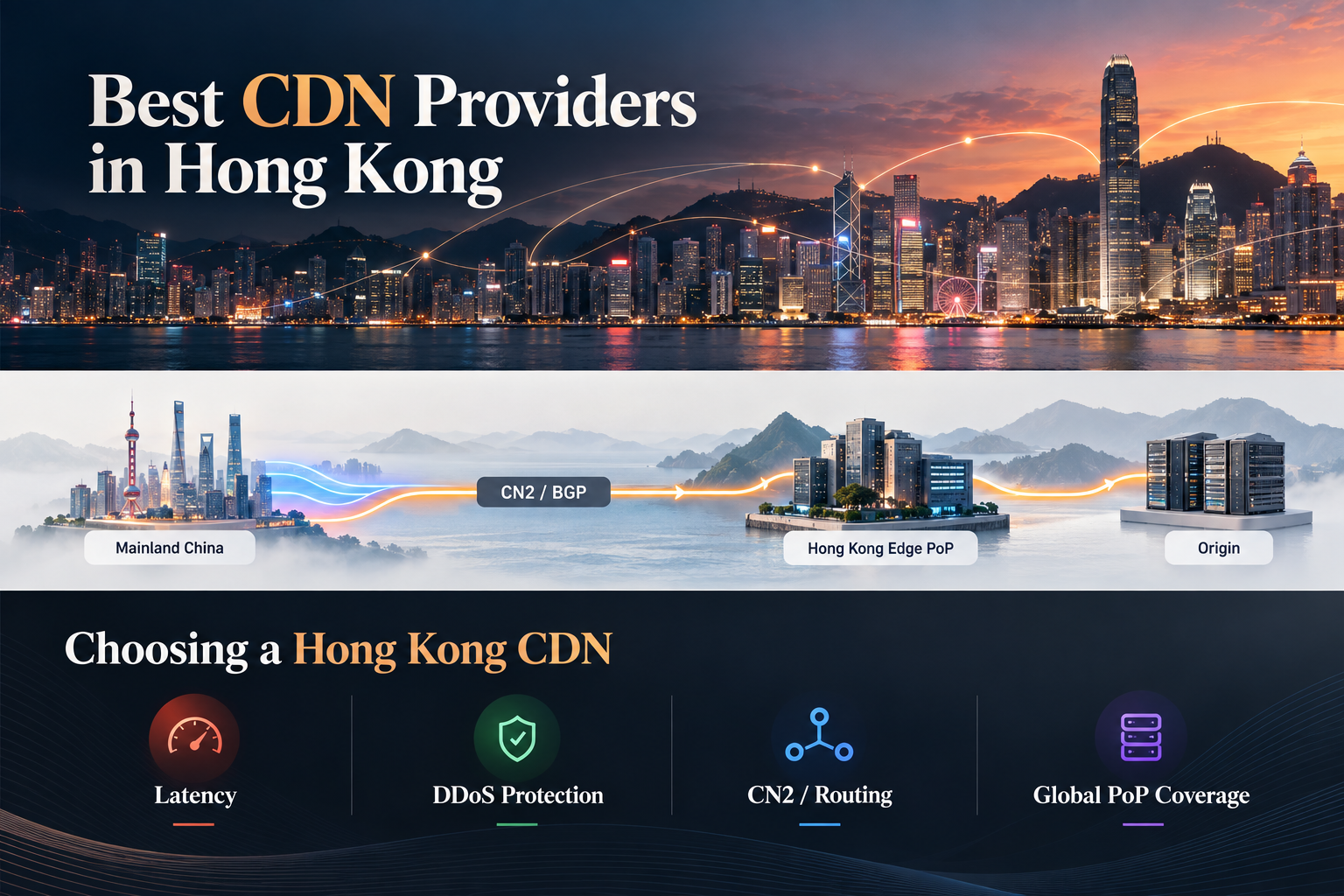
Hong Kong is one of those markets where choosing a CDN is less straightforward than it first appears.
On a map, it looks ideal. Hong Kong sits close to Mainland China, has strong international connectivity, and is one of the major network hubs linking East Asia with Southeast Asia, North America, and Europe. In practice, however, two CDNs with servers in the same city can deliver very different results.
The reason is simple: a Hong Kong PoP is only one part of the path.
Peering quality, upstream carriers, route selection, congestion during Mainland China evening peak hours, origin location, cache hit ratio, and the way dynamic traffic is returned to the origin can all matter more than the number of dots a provider puts on its network map.
That becomes particularly important if your users are split between Hong Kong, Mainland China, Southeast Asia, Japan, and international markets.
For this guide, I focused on CDN providers that make sense for that kind of traffic pattern rather than simply listing the largest CDN brands in the world.
The six services below cover very different use cases: Hong Kong high-defense CDN, CN2-oriented delivery, global Anycast networks, low-cost bandwidth, enterprise China delivery, and conventional pay-as-you-go CDN.
| Provider | Strongest fit | Hong Kong / Asia presence | Security | Mainland China consideration |
|---|---|---|---|---|
| CDN5 | Hong Kong high-defense CDN, cross-border sites | Hong Kong-focused, BGP/CN2 options | DDoS, CC, WAF, Bot controls | Designed around Hong Kong-to-Mainland optimization |
| Cloudflare | Global websites and integrated security | Hong Kong plus a large Asia footprint | Strong DDoS, WAF, Bot stack | Mainland China network is a separate Enterprise service and requires ICP |
| Bunny.net | Low-cost content delivery and media | Hong Kong PoP plus broad Asian coverage | Standard CDN security features | Good regional coverage, but not a dedicated China-optimized network |
| Alibaba Cloud CDN | Businesses serving Hong Kong and Chinese users | Large APAC and China footprint | CDN + broader Alibaba security ecosystem | Mainland China acceleration requires ICP; overseas-only modes can use Hong Kong |
| Akamai | Large enterprise and regulated workloads | Extensive global and Asia delivery infrastructure | Enterprise DDoS, WAF and application security | Offers dedicated China delivery options through its China ecosystem |
| KeyCDN | Developers and smaller international sites | Hong Kong, Singapore, Tokyo, Seoul and other Asian PoPs | Core CDN security features | Straightforward global CDN rather than China-specific acceleration |
The table is useful for narrowing the field, but I would not choose a CDN from a feature matrix alone. If Mainland China traffic matters, test real routes from China Telecom, China Unicom, and China Mobile before moving production traffic.

CDN5 is the most specialized provider in this list.
Rather than trying to be everything to everyone, its Hong Kong offering is built around two problems that frequently show up together: improving delivery into Asia while protecting sites that are regularly hit by DDoS or CC traffic.
That makes it particularly relevant to gaming platforms, cross-border ecommerce, SaaS applications, API services, finance-related platforms, and other businesses that cannot simply put a static cache in front of the origin and call the job finished.
According to CDN5's current product page, its paid high-defense plans combine global acceleration with DDoS protection, CC mitigation, SSL, WebSocket support, and BGP/CN2 networking. The Standard plan is currently listed with 150 Gbps of DDoS protection and 30,000 QPS of CC protection, while higher tiers increase those limits.
What interests me more than the headline mitigation figure is the network design.
For websites trying to reach users in Mainland China without placing the entire application stack inside the mainland, Hong Kong often becomes the practical handoff point. A CDN that understands the difference between ordinary international transit and China-optimized routing can be much more useful than a provider that simply happens to have a Hong Kong server.
That is where CDN5's CN2/BGP positioning becomes relevant.
CN2 should not be treated as a magic word. Route quality still needs to be tested by carrier and time of day. A clean traceroute at 10 a.m. tells you very little about what China Telecom users will see at 9 p.m.
But for projects where Mainland China access is part of the brief, I would at least test a provider that exposes China-oriented routing as a core part of the service rather than an afterthought.
CDN5 is most interesting when security and route quality are equally important.
A conventional CDN can cache a JavaScript bundle perfectly well. The harder job is keeping an application responsive while it is receiving hostile traffic, WebSocket connections, dynamic requests, and origin pulls from users spread across different carriers.
That is the environment CDN5 is clearly targeting.
The trade-off is cost. Once you move beyond a simple CDN and start paying for high-defense capacity and premium network routes, the bill is naturally much higher than a commodity CDN priced purely by bandwidth.
For a small static blog, that would be unnecessary.
For a business where an hour of downtime costs more than the CDN subscription, the economics look very different.
Best suited to:high-risk websites, gaming, cross-border ecommerce, APIs, SaaS, and projects that need Hong Kong delivery with Mainland China-oriented routing.

Cloudflare is the obvious reference point in almost any modern CDN discussion because it combines a huge edge network with DNS, reverse proxying, DDoS mitigation, WAF, bot management, serverless computing, and traffic optimization under one platform.
Its current network map includes Hong Kong and dozens of other Asian locations. Cloudflare lists 71 locations in Asia on its global network page.
For a typical international website, that is a major advantage.
You can put the domain behind Cloudflare, move DNS to its platform, enable caching and security rules, and have a functioning global reverse-proxy CDN without building a complicated delivery architecture.
Where things become more nuanced is Mainland China.
Cloudflare's ordinary global service and its China Networkare not the same product.
Cloudflare states that its China Network is a separate subscription for Enterprise customers and is operated with JD Cloud. Domains using that network require a valid ICP filing or license.
That distinction matters.
A Hong Kong Cloudflare PoP may work perfectly well for a Hong Kong visitor, but it does not automatically mean a user on China Telecom in Guangzhou, Shanghai, or Beijing will receive the same experience as a user connected to an in-mainland Cloudflare/JD Cloud location.
Cloudflare itself notes that traffic entering Mainland China from infrastructure outside the country can face additional latency and reliability challenges.
For websites whose audience is genuinely global, Cloudflare remains one of the easiest platforms to operate.
The security tooling is mature. The DNS infrastructure is excellent. Cache configuration can be as simple or as detailed as you want. And if your architecture eventually becomes more complex, the same platform gives you access to Workers, load balancing, bot management, WAF rules, HTTP/3, and other edge services.
It is especially attractive for teams that want one operational control plane instead of separate CDN, DNS, WAF, and edge-compute vendors.
The main caution is not to assume that "Hong Kong node" and "Mainland China optimization" are interchangeable concepts.
They are not.
Best suited to:international websites, SaaS platforms, ecommerce, developer teams, and companies that want CDN and security managed from the same platform.

Bunny.net takes a very different position in the market.
It is one of the CDN providers I would look at when bandwidth price, simple configuration, and good regional coverage matter more than having an enormous enterprise security stack.
Bunny currently lists 119 global PoPs, including a Hong Kong location, and its Asia network includes 27 PoPs. The company also lists Singapore, Tokyo, Seoul, Taipei, Bangkok, Kuala Lumpur, Manila and several other Asian cities.
That distribution works well for content-heavy sites.
If you are serving software downloads, images, video, static assets, large JavaScript bundles, or other highly cacheable content, Bunny's economics can be attractive.
It also has a high-volume tier in Hong Kong, which Bunny introduced specifically to improve coverage in North and East Asia.
The control panel is refreshingly uncomplicated compared with some enterprise CDN platforms. You can create a pull zone, point it at the origin, configure caching, SSL, hostname settings and edge rules, and get traffic moving without a week of implementation calls.
I would consider Bunny for a company based in Hong Kong that has users distributed across Asia and the rest of the world, especially when the workload is mostly cacheable.
Media sites are an obvious fit.
So are ecommerce image libraries, downloadable assets, software packages, static documentation and high-traffic content sites.
What I would not do is assume that Bunny is a substitute for a dedicated Mainland China acceleration product.
It has good Asian coverage, but its public network proposition is a global CDN, not a China-specific cross-border network built around CN2 or licensed in-mainland delivery.
For Hong Kong, Southeast Asia, Japan, Korea and global users, that may be exactly what you need.
For a business whose primary audience is inside Mainland China, I would benchmark it against China-oriented alternatives before making a decision.
Best suited to:media delivery, static-heavy websites, software downloads, ecommerce assets, and budget-conscious international projects.

Alibaba Cloud deserves a place in this list because its network architecture is fundamentally different from most Western CDN providers when China is involved.
As of August 2026, Alibaba Cloud says its CDN operates more than 3,200 PoPs globally, including more than 2,300 in Mainland China and more than 900 outside the mainland.
That is a major advantage for companies already operating in the Alibaba Cloud ecosystem.
More importantly, Alibaba makes the geographic distinction explicit in its CDN configuration.
You can choose Mainland China, Global, or Global (Excluding the Chinese Mainland)as an acceleration region. In the latter mode, traffic is served from locations outside Mainland China, including Hong Kong, and users connecting from the mainland may be routed to Hong Kong, Japan, or Singapore. Alibaba states that this mode does not require an ICP filing for CDN delivery outside the Chinese mainland.
If you want to use CDN nodes inside Mainland China, however, ICP requirements apply.
That gives businesses a fairly clear choice.
A company that is not ready to complete ICP registration can keep acceleration outside Mainland China and use Hong Kong as one of the nearest delivery points.
A company that has completed the regulatory work can move into a much denser domestic network.
Alibaba has also been expanding its Edge Security Acceleration products for cross-border traffic. Its current documentation describes an Enterprise add-on that routes Mainland China requests through a Hong Kong PoP and its global acceleration network for overseas origins.
If your infrastructure already runs on Alibaba Cloud, the operational advantages are obvious.
You can keep CDN, origin services, security, logging and billing within the same cloud environment.
It also makes sense for larger businesses that treat China as a first-class market rather than an occasional source of traffic.
For a small independent site, Alibaba Cloud can feel heavier than something like Bunny or KeyCDN.
For an enterprise with traffic on both sides of the border, it is much harder to ignore.
Best suited to:China-facing businesses, ecommerce, larger Asian platforms, Alibaba Cloud users, and teams that need both Hong Kong and Mainland China delivery options.

Akamai is not the CDN I would recommend to someone looking for the cheapest terabyte of bandwidth.
That is not really the point of Akamai.
Its value is in large-scale delivery, enterprise security, application acceleration, and the kind of operational support expected by banks, major ecommerce platforms, broadcasters, software companies, and multinational businesses.
For organizations serving China, Akamai maintains dedicated China CDN capabilities designed around compliant content and application delivery, combined with security products such as DDoS mitigation and WAF.
That becomes relevant to Hong Kong because large companies rarely treat Hong Kong as an isolated market.
A typical enterprise architecture may need to serve Hong Kong users, Mainland China customers, Southeast Asia offices, global APIs, mobile apps, video and corporate systems from the same delivery strategy.
Akamai is built for that level of complexity.
Pricing and implementation are the obvious barriers.
Akamai is generally sales-led rather than something you sign up for with a credit card and test for $10.
Configuration can also involve far more planning than a lightweight pull CDN.
That makes it excessive for a personal site or a small startup that simply wants to cache images closer to Hong Kong.
But for an enterprise that has strict uptime, security, contractual support and global-delivery requirements, those same characteristics can become advantages.
Best suited to:large enterprises, financial services, major ecommerce, media, regulated workloads, and organizations with complex global and China delivery requirements.
KeyCDN is one of the quieter names in this list, but that is not necessarily a bad thing.
Its appeal is straightforward: it is a conventional CDN with a simple control model and a network that includes Hong Kong along with Singapore, Tokyo, Seoul and other international locations.
For a developer who understands caching and does not need a massive security platform layered on top, KeyCDN can be refreshingly direct.
You configure a zone, connect the origin, manage cache behavior and start serving assets from the edge.
There is less platform sprawl than you get with the hyperscalers.
Small SaaS products, company websites, documentation sites, blogs, asset delivery and developer-managed web applications are the obvious candidates.
The Hong Kong PoP makes it relevant to Asian traffic, while the surrounding locations give it reasonable regional redundancy.
As with Bunny, I would treat it as a global CDN with an Asian presence rather than a specialist Mainland China acceleration network.
That distinction should guide your testing.
If 10% of your traffic comes from Mainland China, normal international delivery may be perfectly acceptable.
If 80% of your revenue depends on Chinese users, you should be much more demanding about carrier-specific routing, packet loss, P95/P99 latency and evening-peak performance.
Best suited to:developers, smaller businesses, documentation sites, static web assets and international sites that want simple CDN delivery without an oversized platform.
Provider names are useful, but they are not the part that decides performance.
Before moving a production domain, I would test at least the following.
"Shanghai latency" is not a complete measurement.
China Telecom, China Unicom and China Mobile can take very different routes to the same Hong Kong endpoint.
Run the same test from all three.
If your customers are concentrated in a particular province or city, test there as well.
Average latency hides bad periods.
A CDN that delivers 35 ms most of the day and 250 ms every evening may still report a perfectly acceptable daily average.
For production services, the slow tail often matters more than the headline number.
A fast cached object proves that the edge is close.
It does not prove that your application is fast.
Test uncached HTML, API calls, login requests, search, checkout, WebSocket connections and any other dynamic path that has to reach the origin.
This is where poor origin routing becomes visible.
A CDN cannot help much if every request misses cache.
Check whether your Cache-Control headers, cookies, query strings and application logic are preventing the edge from caching assets that should be cacheable.
Cloudflare's own explanation of CDN behavior makes the same basic point: reducing trips back to the origin is one of the main ways a CDN improves speed, reliability and bandwidth efficiency.
A clean benchmark with one browser request is useful, but incomplete.
If the application normally receives thousands of concurrent connections, test the CDN and origin under a realistic load profile.
Pay attention to connection reuse, TLS handshake time, queueing, upstream saturation and origin protection.
This is probably the most common misunderstanding.
A site can use Hong Kong or other overseas CDN locations without deploying CDN nodes inside Mainland China.
That does notmake the service equivalent to a licensed mainland CDN.
Cloudflare requires ICP for its China Network, and Alibaba Cloud likewise distinguishes between mainland/global acceleration and its outside-mainland acceleration mode.
If a provider advertises "China acceleration without ICP," look carefully at what that actually means.
In many cases, it means the service is optimizing traffic toward Hong Kong or another nearby offshore location, not operating an unregistered CDN node inside Mainland China.
That can still be extremely useful. It is simply a different architecture.
For a small global website with mostly static content, I would start by testing Bunny.net, Cloudflare, and KeyCDN.
For a business where security attacks and Mainland China-oriented Hong Kong routing are central requirements, CDN5 belongs on the shortlist.
For companies already invested in Chinese cloud infrastructure or planning a formal Mainland China deployment, Alibaba Cloud offers a much deeper domestic and cross-border ecosystem.
For large enterprises that need contractual support, application security and complex multi-region delivery, Akamai remains a different class of product entirely.
The key point is that there is no universal "fastest Hong Kong CDN."
The fastest provider for a cached image requested from a Hong Kong broadband connection may not be the fastest provider for an API request coming from China Telecom in Beijing at 9 p.m.
The only reliable way to choose is to put your own traffic pattern in front of the CDN.
Start with two or three providers. Use the same origin, the same test files and the same cache policy. Measure DNS time, TCP connect time, TLS negotiation, TTFB, download time, cache hit ratio, packet loss, and performance during evening peak hours.
Then keep the provider that performs best for your users, not the one with the most impressive network map.

 Enrique Fay
Aug 06, 2024
 Enrique Fay
May 22, 2025
 Enrique Fay
Aug 11, 2024
 Enrique Fay
Mar 17, 2025
 Enrique Fay
Aug 11, 2024