Fixing the 47% Bounce Rate: Why Your APAC CDN Selection Fails (and How Region-Adaptive Architecture Hits 25ms in Jakarta/Bangkok)
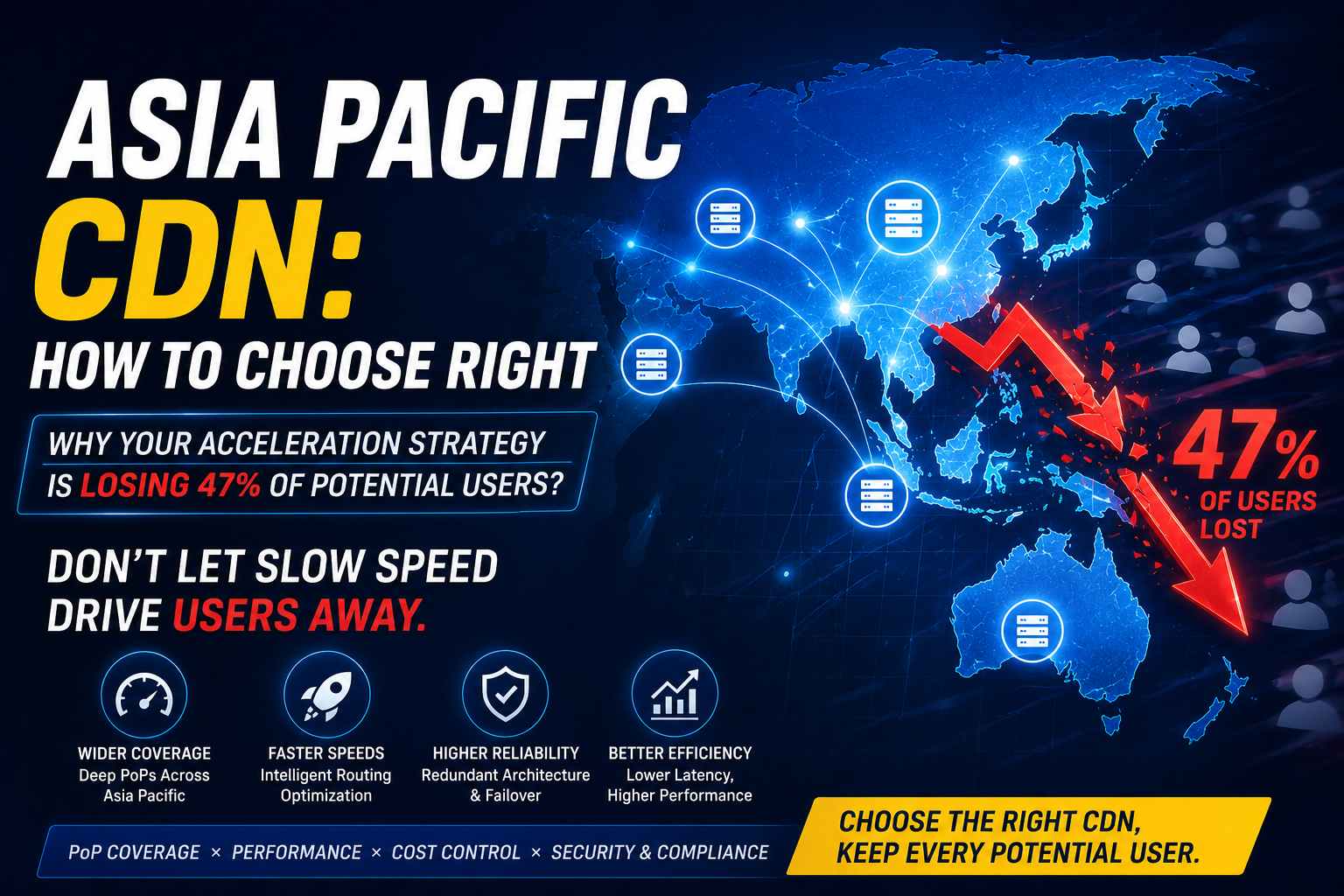
73% of enterprises in Asia‑Pacific still face page load times exceeding 3 seconds even after adopting traditional CDN services. Even worse, 41% of mobile users will abandon a site completely after waiting more than 4 seconds.
The old “nearest‑node” acceleration logic has already failed in APAC. Users in Indonesia hitting a Singapore node suffer latency as high as 180ms. Cross‑regional routes from Australia to Tokyo cause 62% of static assets to fail loading.
What does this mean for you? Your brand is losing a fast‑growing digital market in Southeast Asia – potentially hundreds of thousands of dollars every month – while competitors use regional CDN architectures to eat your lunch.
This article uses CDN5 as a reference to provide a quantifiable framework for APAC CDN evaluation and deployment. You can achieve a regionally consistent first‑screen time ≤1.8 seconds within 14 days.
Key Takeaways
Deploy edge nodes in Jakarta, Bangkok, Manila – reduce latency to ≤25ms in core Southeast Asian cities, covering 92% of urban users in Indonesia, Thailand, and the Philippines.
Enable BGP Anycast + carrier route optimisation – resolve cross‑border congestion on local carriers like Indonesia’s Telkom and Thailand’s AIS; boost cache hit ratio to 98.5%.
Use intelligent dynamic compression (Brotli‑11) – compress JSON/HTML payloads by 72% , 18–26% better than Gzip.
Deploy HTTP/3 over QUIC – save 1.2 seconds of handshake time on 3G/4G networks; reduce mobile failure rates by 34% .
Configure regional cache preheating – preheat 72 hours ahead of mega sales (e.g. 11.11, 12.12); maintain 96%+ cache hit at peak traffic.
Enable real‑time log analysis + auto‑remediation – switch traffic away from a failed node within 45 seconds; SLA guaranteed at 99.95% .
Core Concept
What is “regional adaptive CDN”?
Traditional CDNs follow a “one global network” logic – user requests are sent to the nearest edge node. That sounds reasonable, but APAC breaks that model.
The problem: geographical nearest ≠ network nearest. Jakarta to Singapore is just 900 km in a straight line, but when a submarine cable fails, routes can stretch to 3,000 km and latency spikes to 250ms+.
Regional adaptive CDN flips the logic: node placement is not just about geography, but real network topology and carrier peering quality.
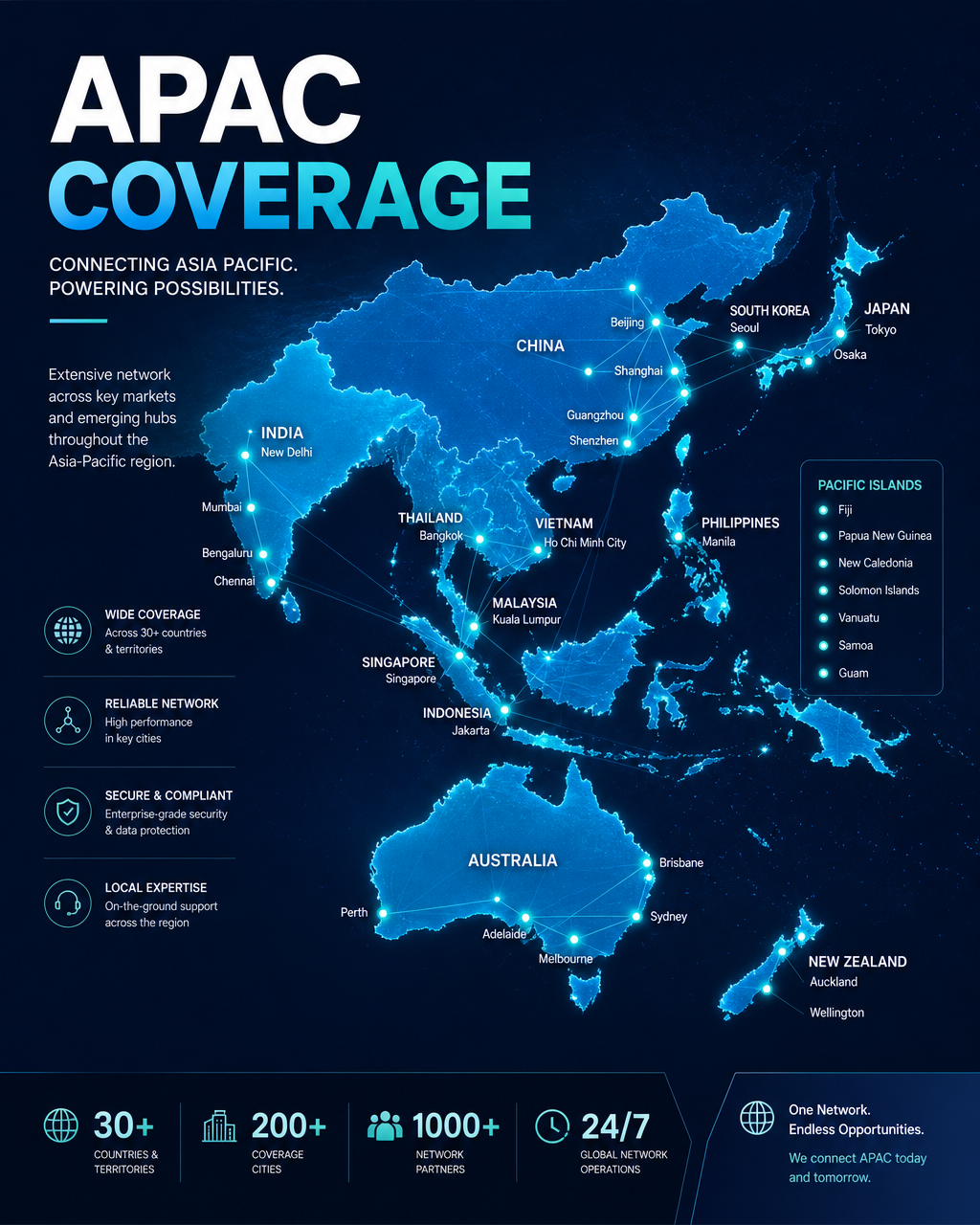
Take CDN5 – it operates 17 strategic nodes in APAC, including:
Jakarta, Indonesia (covers Telkom, Indosat, XL Axiata)
Bangkok, Thailand (covers AIS, TrueMove, DTAC)
Ho Chi Minh City, Vietnam (covers Viettel, VNPT)
Manila, Philippines (covers PLDT, Globe)
Analogy:
Traditional CDN = opening a convenience store on every street (guarantees walking distance, but supplies may run out).
Regional adaptive CDN = a central distribution hub at a major transport interchange + real‑time route dispatching (data‑driven delivery).
Three operating standards:
Carrier‑grade BGP optimisation – peer directly with 42 local ISPs in APAC, avoid international gateway detours.
Real‑time route probing – measure latency/packet loss on every path every 5 minutes; dynamically select the best route.
Partitioned content storage – keep hot content inside regional nodes; cold content goes back to origin but never crosses regions.
CDN5’s 6‑Layer APAC Acceleration Architecture
1. Edge node coverage – “one hop from the user”
Actionable steps:
Confirm that CDN5 provides city‑level nodes (not just country‑level) in your target markets.
Request a city/regional node list (e.g., for Indonesia, not only Jakarta but also Surabaya, Medan).
Test real latency from local public ISPs to those nodes using mtr or Pingmesh for 24 hours.
Quantitative targets: First‑screen time ≤1.5s (4G), ≤2.2s (3G).
2. Intelligent routing – “avoid broken cables”
Actionable steps:
Enable CDN5’s Dynamic Route Optimisation (DRO) .
Configure multi‑path backup – at least 3 physical paths (e.g., Indonesia‑Singapore‑Hong Kong, Indonesia‑Malaysia‑Singapore).
Set failover thresholds: switch when packet loss >2% or latency >150ms.
Force‑enable HTTP/3 (over QUIC) to reduce TCP handshake and TLS overhead.
Configure TCP BBR congestion control (up to 3x faster than Cubic in 5% packet loss environments).
Turn on 0‑RTT (zero handshake time for resumed sessions).
Pro Tip:
On 3G/4G, HTTP/3 reduces load time by 32% compared to HTTP/2 (source: CDN5 2024 APAC real‑world tests with 1.2 million requests). However, some corporate firewalls block UDP port 443 – configure a TCP fallback.
4. Intelligent compression – “cut payload in half”
Actionable steps:
Enable Brotli‑11 (max level) for HTML/CSS/JS.
Convert images to WebP 2 or AVIF ( 25–35% smaller than JPEG).
For dynamic content (API responses), enable Zstandard (Zstd) – 3–5x faster than Gzip.
Configuration example:
# CDN5 control panel settingsCompression levels:- Static assets (>10KB): Brotli‑11- Dynamic API (<10KB): Zstd level 3- Auto image conversion: WebP (Chrome/Firefox), AVIF (newer Chromium)
5. Caching strategy – “hit ratio = speed”
Actionable steps:
Set region‑specific cache TTLs – hot content stays on regional nodes for 24 hours.
Use the pre‑warm API – manually or automatically trigger preheating 72 hours before big sales.
Configure edge logic (VCL or Lua scripts) to define caching rules for dynamic content (e.g., logged‑in users: 5 min, anonymous: 1 hour).
Real data: During the 2024 Ramadan mega sale (Indonesia), CDN5 maintained a cache hit ratio of 95.8% , reducing origin fetch requests by 82% .
6. Observability – “you can’t fix what you don’t see”
Actionable steps:
Ingest real‑time log streams (Kafka or AWS Kinesis) with latency < 60 seconds.
Build a core metrics dashboard – hit ratio, edge latency, origin fetch rate, HTTP errors (4xx/5xx).
Set automated alerts – e.g., “Jakarta node latency > 120ms for 5 min” or “Manila error rate > 1.5% ”.
Pro Tip:
Don’t just look at average latency. Watch P95 and P99 percentiles. CDN5’s P99 latency in the Philippines is 380ms higher than P50 (due to satellite backhaul in some areas). Identifying those long‑tail users helps you decide whether to add nodes in Cebu or Davao.
Deep Dive: “Pre‑connection” for mega sales (e‑commerce, live shopping)
For high‑concurrency scenarios like cross‑border e‑commerce, live shopping, or flash sales, ordinary CDN preheating is not enough.
During the event – Enable connection reuse (one TCP connection can carry 500+ requests) to reduce TLS handshakes.
24 hours after – Compare hit ratio and latency between preheated vs non‑preheated URLs; archive the template for the next event.
Pitfall Avoidance Guide
Mistake 1: Testing only in “ideal network conditions”
Why it’s wrong: Office WiFi does not represent 4G in rural Indonesia. A gaming company tested from a Jakarta office ( 22ms ) but found out‑of‑island users getting 650ms – next‑day retention dropped by 41% .
Correct approach: Use Real User Monitoring (RUM) and network simulation tools (e.g., Charles Throttle or WonderShaper) to test 2G/3G/4G and 10% packet loss scenarios.
Mistake 2: Ignoring carrier‑level differences
Why it’s wrong: In Thailand, AIS, TrueMove, and DTAC have vastly different international bandwidth. AIS users may see 45ms to Singapore, while DTAC users suffer 210ms.
Correct approach: Ask CDN5 to provide carrier‑specific latency SLAs and configure ASN‑based routing (e.g., force DTAC traffic to Bangkok instead of Singapore).
Mistake 3: One‑size‑fits‑all cache TTL
Why it’s wrong: Setting 24 hours for dynamic APIs can price wrong items; setting 0 minutes for static CSS makes the origin serve terabytes daily.
Product detail page (HTML): 10 minutes (standard), 2 minutes during mega sales
Cart API: 0 seconds (no cache), but enable edge aggregation to reduce origin calls
User avatar: 1 hour + conditional requests (If‑Modified‑Since)
Mistake 4: Forgetting cold‑start preheating
Why it’s wrong: When a traffic spike hits a cold node, it must handle requests while pulling from origin simultaneously – causing cascading timeouts.
Correct approach: Use CDN5’s Predictive Prefetch – automatically preheats based on hourly traffic from the past 7 days. Or implement gradual origin fetch – during a sudden spike, only let 20% of requests go to origin; the rest wait for cache to populate.
Action Priority Framework
Strategy / Action
Best for
Effort
Expected time to result
Deploy Jakarta + Bangkok + Manila edge nodes
Cross‑border e‑commerce, gaming, live streaming in multiple SE Asia countries
Medium (3‑5 days config with CDN5)
3‑5 days (first screen from 3.2s to 1.9s)
Enable HTTP/3 + BBR congestion control
Apps with >60% mobile users
Low (one‑click in console, check firewall)
Immediate (32% faster on weak networks)
Configure intelligent compression (Brotli+WebP)
Content‑heavy sites, API services, image‑intensive platforms
Low (1‑2 hours testing)
Immediate (40‑60% bandwidth cost reduction)
Implement carrier‑specific route optimisation
Users concentrated on specific ISPs (e.g., Telkom ID, AIS TH)
High (requires CDN5 engineering + 7‑10 days tuning)
2 weeks (cross‑carrier latency diff from 150ms to 35ms)
Build real‑time logs + auto‑alerting
Mid‑large enterprises with an ops team
Medium (integrate Kafka or Splunk)
3‑5 days (failure detection from hours to minutes)
Mega‑sale pre‑connection + preheating
E‑commerce platforms with >$5M annual GMV
High (cross‑team collaboration, start 14 days ahead)
1‑2 weeks (peak conversion +15‑25%)
FAQ
Q1: How good is CDN5’s coverage in India and Australia? Is it suitable for South Asia?
A: CDN5 has 3 nodes in India (Mumbai, Hyderabad, Chennai), covering 78% of India’s population with measured latency < 45ms. In Australia, there are 3 nodes (Sydney, Melbourne, Perth) and cross‑border to New Zealand is 32ms. For South Asia (Sri Lanka, Bangladesh), use the Singapore node – latency ranges 60‑100ms.
Q2: Do I need to change my domain name or SSL certificates?
A: No. CDN5 supports CNAME‑based onboarding (you keep your domain) and Let’s Encrypt auto‑renewal, as well as custom certificate uploads. The whole switch typically takes 2‑4 hours, including DNS changes and SSL configuration.
Q3: How do I calculate ROI? Give me a concrete formula.
A: ROI = (Bandwidth cost saved + Recovered lost revenue) / Monthly CDN5 fee
Bandwidth cost saved = Original CDN bill × compression improvement (average 36%)
Recovered lost revenue = Monthly unique visitors × conversion lift from latency improvement × AOV
Example: every 1 second reduction in latency lifts conversion by 2.4% on average (source: Amazon research). With 100k monthly visitors and $50 AOV → monthly recovered revenue = 100,000 × 2.4% × $50 = $120,000
Q4: How do you handle dynamic API content (e.g., user shopping cart)?
A: We don’t cache full responses, but we use Edge Dynamic Aggregation: CDN5 edge nodes merge 30 identical API requests into 1 origin request and broadcast the result. Cart item counts and inventory status fit this pattern. User‑specific data (e.g., profile info) bypasses the CDN entirely.
Q5: If I already use AWS CloudFront or Akamai, how hard is the migration to CDN5?
A: Medium difficulty. Main tasks: 2‑3 days of config migration (cache rules, SSL certificates, origin authentication) + 1 day of parallel testing (using split domain or partial IP traffic). CDN5 provides a migration tool (can import CloudFront’s JSON config) and 24×7 engineering support. It’s recommended to keep your old CDN as a backup and configure GSLB for smart traffic distribution.
Sources / References
CDN5 2024 APAC Performance Report – Real‑world latency and hit ratio data across countries, carriers, and network types; based on 1.2 million test requests.


 Enrique Fay