No products in the cart.

What should you do when your website is under a DDoS attack? Master essential countermeasures like traffic scrubbing and IP hiding to ensure stable access. We recommend 5 high-protection CDN services that quickly block attack traffic and keep your business running without interruption.
sses an average of $6,130 per minute of downtime. According to the Indusface State of Application Security Report 2026, 70% of websites experienced at least one DDoS attack in 2025, attack volume per site grew 27% year over year, and APIs were 675% more likely to be targeted than traditional websites. Today, short‑duration attacks lasting just 2–3 minutes have become the norm – designed to finish before most response teams ever get an alert – while credential stuffing and account takeover quietly run in the background.
Preventing DDoS attacks in 2026 requires far more than bandwidth and firewalls. It needs behavioral detection, layered defenses, and the readiness to respond before damage escalates. This guide covers 15 battle‑tested DDoS prevention best practices, organized by phase so you can prioritize based on where your current defenses fall short.
Every second without DDoS protection is a window attackers can use.
Here are the core actions that stop most attacks before they cause real damage:
Hide your origin server IP behind a WAF or CDN – prevent attackers from bypassing edge defenses and hitting your infrastructure directly.
Apply behavioral rate limiting per endpoint, not static thresholds – distributed attacks keep each source below a static limit but overwhelm the application as a whole.
Tier your assets by criticality – put login pages, payment APIs, and business‑critical flows under the strongest protection, not the same level as static marketing pages.
Use always‑on DDoS protection for sub‑second response – those 2‑to‑3‑minute short attacks finish before on‑demand mitigation even kicks in.
Practice your incident response before an attack hits – organizations with a well‑drilled, documented plan recover in minutes; without one, recovery takes hours.
The 15 practices below build on these core principles and give you specific guidance for websites, networks, APIs, and routers.
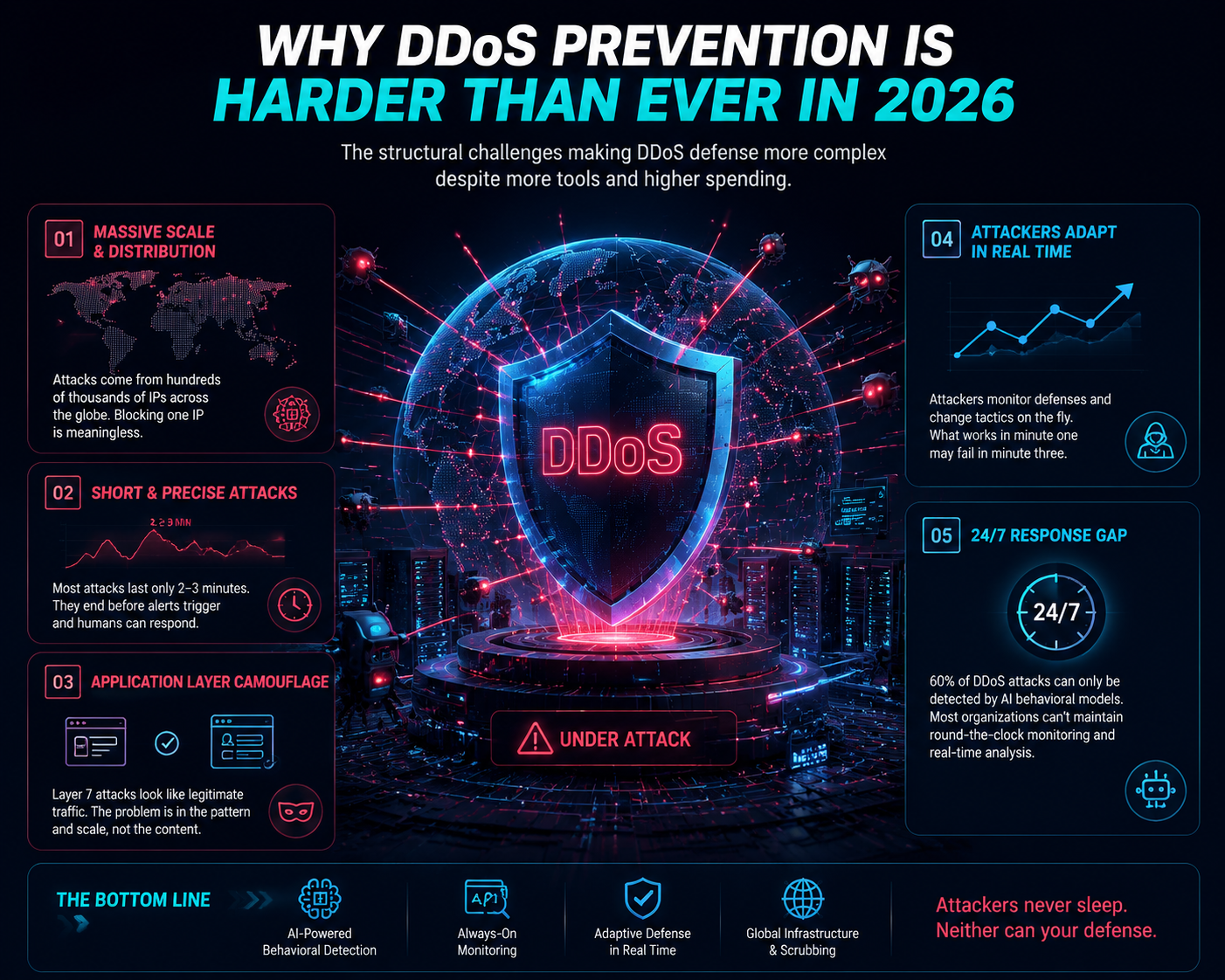
Understanding the structural challenges of DDoS defense helps explain why so many organizations stay at risk even after investing in protection.
Attack scale and distribution make IP blocking useless. Modern DDoS attacks come from botnets that span hundreds of thousands of geographically dispersed IPs. Block one source and thousands more are still sending traffic. That volume alone can overwhelm most networks before a security analyst can react.
Short, precise attacks finish before defenses kick in. The dominant attack pattern in 2025 was a 2–3 minute flood from a distributed IP pool – timed perfectly to end before static thresholds trigger and before human response teams get an alert. Static rate limits can’t stop what’s already over before anyone is paged.
Application‑layer attacks masquerade as legitimate traffic. Every single HTTP request in a layer‑7 DDoS looks completely normal on its own. The problem is the scale and pattern of requests, not the packet contents. Without per‑endpoint behavioral baselines, signature‑based defenses can’t tell a malicious flood on a login endpoint from a legitimate traffic spike.
Attackers change tactics in real time. Advanced attackers monitor how defenses react and adjust their strategy on the fly. What works in minute one may be bypassed by minute three. Only behavioral models that continuously update can keep up with adaptive attacks.
Most organizations can’t sustain 24/7 DDoS response. 2026 reports show that 60% of DDoS attacks can only be identified by AI‑driven behavioral models – static rate limiting alone won’t catch them. Effective DDoS defense requires round‑the‑clock monitoring and real‑time analysis, something most teams can’t maintain in‑house.
DDoS attacks have evolved from crude bandwidth floods into precision weapons. Short attacks finish before alerts fire. API endpoints get hit 675% more often than traditional websites. Credential stuffing runs in parallel while response teams scramble against the flood. Static defenses built for yesterday’s attacks don’t stop today’s.
These 15 practices are grouped into five phases: understand your risk, reduce your exposure, detect early, build proactive defenses, and plan for business continuity. If you’re building DDoS defense from scratch, follow the phases in order. If you already have a plan, use the phase structure to spot where your current approach is missing something.
You can’t defend what you don’t know. Before investing in any DDoS tool or technology, figure out what you’re protecting, who might attack you, and which assets matter most. This phase determines the success of your entire DDoS plan – organizations that skip it end up spending money protecting the wrong things.
Quickly recognizing the attack type before it causes real damage is the foundation of any DDoS defense plan. Different attack types target different layers and environments. Knowing which threat you’re facing tells you which defense to use.
Layer‑7 HTTP floods use massive numbers of GET, POST, or API requests to attack websites and web applications. They consume application server CPU, not bandwidth, so network‑layer defenses can’t stop them. Login pages, checkout flows, and search functions on websites are prime targets. Each request looks legitimate by itself, and the attack concentrates firepower on a single endpoint.
UDP amplification attacks target network infrastructure by abusing open DNS or NTP servers to amplify attack traffic – a small request from the attacker triggers a large response from the server. This is a network‑layer attack aimed at saturating bandwidth, not crashing applications. Routers with directly exposed network infrastructure and no ingress filtering are the most vulnerable.
DNS floods overwhelm DNS resolvers with so many queries that legitimate users can’t resolve domain names. These attacks hit both websites and network infrastructure – even if your web servers are perfectly healthy, users can’t reach you if DNS is down. Typical signs include DNS timeouts or partial connectivity (e.g., you can reach the site by IP but not by domain name).
Short, precise attacks were the dominant pattern in 2025: 2‑to‑3‑minute rapid attacks from a distributed IP pool aimed at a specific website or API endpoint, timed to finish right before auto‑alerts would trigger. These are application‑layer attacks designed to exploit the gap between detection and response.
Knowing each attack type lets you apply the right defense. UDP amplification needs network‑layer scrubbing; HTTP floods need application‑layer behavioral detection. Using the wrong defense wastes precious response time and leaves the real attack vector untouched.
The difference between reactive and proactive defense is whether you have a threat model. Without one, you’re always patching for the last attack. With one, you anticipate before anything hits.
Inventory all your internet‑facing assets – build a complete list of web applications, APIs, DNS infrastructure, CDN origins, network endpoints, and routers. Don’t miss assets managed by other teams: shadow APIs and undocumented endpoints are frequent DDoS targets because nobody is monitoring them. For websites, record every public URL. For networks, record every externally reachable IP and port. For smaller organizations, include routers and network edge devices – they’re both attack targets and botnet recruitment vectors.
Identify the real threat actors for your industry. Financial services face nation‑state actors and financially motivated attackers who use DDoS as a smoke screen for fraud. E‑commerce has to worry about competitors and extortionists who time attacks for peak sales periods. Healthcare deals with hacktivists who use DDoS as a distraction while they probe for patient data vulnerabilities. Different actors have different capabilities, preferred vectors, and target selection logic.
Map attack vectors to specific assets. A high‑traffic login endpoint on a website is a dual target for application‑layer floods and credential stuffing. A payment API is a prime target for resource‑exhaustion attacks during transaction peaks. DNS infrastructure is a target for amplification attacks. A network router with stale firmware is a prime botnet recruitment target.
Assess risk by likelihood and impact. Prioritize based on which attacks are most likely to target your specific environment and which would cause the most damage. This avoids the classic mistake of over‑investing in a theoretical attack while leaving a high‑probability vector unprotected.
Not all assets carry the same business risk when they’re hit. A DDoS plan that treats every asset the same ends up sacrificing critical assets while protecting low‑value ones.
Before an attack happens, split all your internet‑facing assets into three tiers:
Critical – assets whose downtime directly impacts revenue, compliance, or safety. For websites, this means login pages, checkout flows, and payment APIs. For networks, that’s DNS resolvers, routing infrastructure, and primary internet uplinks. For APIs, it’s authentication endpoints and transaction flows. These need always‑on protection and the fastest response times.
High priority – assets whose disruption affects daily operations but doesn’t cause immediate financial or compliance consequences. Admin panels, reporting dashboards, and internal APIs fall here. They need protection, but response times can be slightly slower than critical assets.
Routine – everything else: marketing pages, static assets, non‑transactional endpoints. Standard rate limiting and CDN caching are enough.
There’s also an extra bucket: deprecated assets. Old systems and unused APIs that are still online but lack active monitoring are frequent DDoS targets – attack them because nobody pays attention. Take them offline immediately or put explicit deny rules in place. Even if the application itself is dead, as long as those website endpoints resolve, attackers can use them to chew up shared infrastructure resources.
The cheapest DDoS defense is removing an attack surface before it can be used. Every internet endpoint you don’t need is a potential target. Every service you aren’t using is a vulnerability. This phase is about shrinking what an attacker can even reach before you spend a dollar on detection or mitigation.
Hide origin server IPs – all website traffic must route through a WAF or CDN. If your origin IP can be found via DNS history, SSL certificate transparency logs, or subdomain enumeration, attackers can bypass every edge defense and send attack traffic straight to your web server. No public‑facing website or application should leak its origin IP.
Remove unused services and legacy endpoints – every unused port, deprecated API, and old application endpoint is a potential DDoS entry point. Audit your internet‑facing services quarterly. Those legacy API endpoints that still resolve but aren’t maintained have no monitoring, no rate limiting, no active defense – they’re the easiest win on the attack surface.
Aggressively cache static assets at the edge – DDoS attacks against websites aim to exhaust web server CPU by forcing it to process requests that need backend work. Serve images, scripts, stylesheets, and downloadable files from CDN edge nodes, not from your origin. Those requests never hit the attackable footprint. Attackers can’t exhaust server resources with requests that never reach the server.
Use geo‑blocking where it makes sense – if your website users are concentrated in certain regions, restrict traffic from countries where you have no legitimate user base. This won’t stop a determined attack (botnets are widely distributed), but for organizations with a geographically focused user base, it meaningfully reduces the attack surface.
Enable ingress and egress filtering at your network border – ingress filtering stops traffic with spoofed source IPs before it enters your network; egress filtering prevents your own network from being used as an amplifier to attack other organizations. Both are low‑cost and dramatically reduce the risk of volumetric and amplification attacks.
Segment your network – put web servers in a public subnet and databases in a private subnet not directly exposed to the internet. Limit database access only to application servers. Even if attackers successfully overwhelm the public‑facing server layer, segmentation keeps them away from high‑value backend resources. For complex infrastructures, segment further by sensitivity – for example, put payment processing in a separate network zone with tighter access controls than ordinary web servers.
Harden routers against DDoS and botnet recruitment – routers are both DDoS targets and botnet recruitment vehicles. Change default admin credentials on every network device immediately – most router compromises start with default usernames and passwords that were never changed. Turn on automatic updates for router firmware (or do manual updates monthly). Disable UPnP, remote management, and unused port forwarding rules. All of these expand your router’s attack surface, and UPnP in particular is frequently abused for amplification attacks. On enterprise routers, disable remote management completely unless you absolutely need it.
Protect DNS infrastructure – use a managed DNS provider with built‑in DDoS protection. Deploy DNSSEC to prevent DNS poisoning. Restrict or disable open recursive DNS resolution on your infrastructure. Even if everything else is healthy, a successful DNS flood can take your entire organization offline by making domain names unresolvable.
Infrastructure that crashes under sudden load is just as broken as infrastructure that can’t stop an attack. Surge readiness lets you handle both legitimate traffic peaks and volumetric DDoS attacks.
Integrate a globally distributed CDN – an Anycast CDN distributes attack traffic across many geographically dispersed edge nodes, absorbing it before it reaches your origin infrastructure. The attack volume gets diluted across the entire network instead of concentrating on one point. For websites, CDN integration also offloads legitimate traffic spikes (flash sales, product launches, viral content) from origin servers – so you don’t mistake normal bursts for attacks.
Choose unmetered DDoS protection over usage‑based billing – DDoS protection that charges by attack volume or bandwidth consumption creates a bill shock crisis on top of your business disruption when you face a terabit‑scale attack. Unmetered protection absorbs attacks of any size at a flat rate, removing unpredictable costs exactly when your business is under maximum stress.
Set up upstream scrubbing with your ISP – for attacks larger than your edge network can handle, ISP‑side scrubbing drops attack traffic before it ever reaches your network. Establish this relationship ahead of time and test the signaling mechanism before you need it. Activating upstream scrubbing while you’re already under attack involves a slow, painful process that extends the damage window.
Early detection is the difference between a 10‑minute DDoS incident and a 4‑hour outage. The 2‑to‑3‑minute short attacks that dominated in 2025 are specifically designed to finish before detection systems can alert. This phase is about closing that gap – identifying an attack before it causes irreversible damage, and having monitoring in place to catch attack patterns that automated systems alone might miss.
DDoS early warning signs overlap with other infrastructure problems – hardware failures, misconfigurations, and legitimate traffic spikes produce similar symptoms. Here’s how to tell DDoS apart:
Traffic concentrated on a single endpoint – normal traffic growth is spread across all pages and endpoints proportionally. DDoS attacks concentrate on a specific URL, API, or service. When login page requests spike while everything else stays normal, that’s an application‑layer DDoS signal, not a normal traffic burst.
Unusual geographic distribution – normal traffic spikes match your user geography. Botnet traffic doesn’t. Unexpected traffic from countries or regions outside your normal user base – especially when it starts suddenly instead of ramping up – signals a distributed attack.
Homogeneous request characteristics – normal users generate diverse request characteristics: different user agents, referrers, parameter values. Botnets generate identical or near‑identical characteristics at scale. A large number of requests sharing the same user agent or header set is a botnet signal.
CPU exhaustion with normal bandwidth – application‑layer DDoS attacks consume web server CPU while network bandwidth stays normal. If your application server CPU is pegged at 100% but your network interfaces show normal utilization, the attack is at the application layer, not the network layer – and network‑layer defenses won’t stop it.
DNS resolution fails while servers are healthy – if users report they can’t reach you but your web and application servers respond fine, the attack may be targeting DNS infrastructure rather than your applications directly.
Continuous log monitoring is both your earliest detection method and the foundation for post‑incident forensics. Attacks that slip past automated detection often leave signs in log patterns before they cause significant damage.
Set up automated alerts based on behavioral baselines – calibrate alert thresholds to your application’s normal traffic patterns so they fire only on genuine anomalies, not every minor fluctuation. A login endpoint that normally receives 500 requests per hour should alert at, say, 5,000 per hour. Apply that same threshold to a homepage that normally gets 50,000 per hour and you’ll drown in false positives.
Correlate logs across network, application, and CDN layers – an application‑layer attack may show normal bandwidth at the network layer while causing CPU exhaustion at the application layer. Cross‑layer log correlation catches attacks that single‑layer monitoring misses – especially critical for short attacks that impair application performance without triggering network‑layer thresholds.
Keep logs for at least one year – post‑incident forensics need historical data to identify attack patterns, trace sources, and document events for compliance and legal reasons. Keeping only a few weeks of logs loses the historical baseline needed to recognize recurring attack behavior or slow‑building threats.
Push logs to a SIEM in real time – SIEM integration lets you correlate log data with threat intelligence feeds and other security signals across your environment. Multi‑vector attacks span different systems and layers; they’re only fully visible when log data from every source lives in one place.
Prevention and detection shrink your exposure and speed up identification. But when an attack actually arrives, proactive defenses are what stop it. This phase covers the controls that intercept attack traffic before it reaches your infrastructure – from behavioral rate limiting that adapts in real time to emergency measures for attacks that exceed normal mitigation capacity. Putting these defenses in place before an attack hits is the difference between weathering a DDoS event and being taken down by it.
Rate limiting is one of the most widely deployed DDoS defenses and one of the most misconfigured. Applying the same static rate limit to all traffic is trivially bypassed by distributed attacks – each source stays below the threshold while the aggregate overwhelms the application.
Behavioral rate limiting builds a baseline of normal request patterns for each endpoint and each user session, then applies limits relative to that baseline. Take a payment API – under normal conditions it might see ~200 requests per minute per authenticated session. Limits for that endpoint are designed around that threshold. A one‑size‑fits‑all rule either blocks legitimate traffic on high‑value endpoints or provides insufficient protection. Per‑endpoint behavioral limits eliminate both failure modes.
Per‑endpoint behavioral rate limiting is especially critical for API endpoints. In 2025, APIs were hit 675% more often than traditional websites. Applying a single rate limit across the entire API layer will either block legitimate high‑volume integrations or leave low‑volume but sensitive endpoints – like authentication and payment endpoints – underprotected.
Behavioral rate limiting also prevents false positives during legitimate traffic spikes. A flash sale might drive 10x normal traffic to a checkout endpoint. To a static rate limit, that looks exactly like an attack. A behavioral limit that understands this endpoint’s normal pattern during promotional events won’t block real buyers.
CAPTCHAs and cryptographic challenges are secondary controls that reduce automated attack traffic at the application layer. You can deploy both on high‑value endpoints – it’s not an either‑or decision.
CAPTCHAs verify human presence before granting access to high‑value endpoints like login pages, registration forms, and checkout flows. Modern CAPTCHAs use behavioral signals (mouse movements, keystroke patterns, browser fingerprinting) rather than visual puzzles – most legitimate visitors barely notice them. Deploy CAPTCHAs only on endpoints with the highest DDoS risk, not site‑wide. Putting CAPTCHAs on every page adds user friction with no real security benefit for low‑risk pages.
Cryptographic challenges impose a computational cost on each request, making large‑scale automation economically unattractive. When your application server is under DDoS pressure, proof‑of‑work challenges at the edge can dramatically reduce the volume of requests that need backend processing. For API endpoints – where there’s no browser environment and CAPTCHAs won’t work – cryptographic challenges paired with client certificate authentication achieve a similar effect.
Blackhole routing sends attack traffic to a null interface, dropping it before it ever reaches your target infrastructure. It’s a blunt instrument: all traffic to the target IP – legitimate and attack – is dropped. But when attack volume exceeds your mitigation capacity and your primary goal is keeping upstream infrastructure from collapsing, it’s effective.
Enable blackhole routing when attack volume exceeds your mitigation capacity. Because it blocks legitimate users along with attackers, it’s not a substitute for behavioral mitigation.
Remotely triggered blackhole routing lets you notify your upstream ISP to drop traffic before it enters your network – especially effective against massive attacks. Establish ISP relationships ahead of time and test the signaling mechanism before you need it. Switch from blackhole routing back to more precise behavioral filtering as soon as conditions allow, to restore access for legitimate users.
Your infrastructure is both a DDoS target and a potential DDoS weapon. Compromised corporate servers, cloud instances, and routers get recruited into botnets used to attack other organizations. When your infrastructure is used as a botnet node, you face abuse complaints, IP reputation damage, and increased outbound traffic costs – on top of inbound attacks.
Patch management is priority one – most botnet compromises exploit known vulnerabilities in unpatched systems. Set clear remediation timelines for critical vulnerabilities and automate patching wherever you can. The longer a known vulnerability stays exposed, the wider the window for botnet recruitment.
Monitor outbound traffic for anomalies – healthy servers don’t initiate large volumes of outbound connections to random IPs. Set up automated alerts for anomalous outbound traffic (high volume to unfamiliar destinations, connections to known C2 infrastructure, or unusual ports). Early detection of outbound anomalies catches botnet recruitment early.
Enforce strong password policies on every internet‑facing admin interface – many botnet recruitments start with credential stuffing against exposed router admin panels, SSH interfaces, and management consoles. Enable multi‑factor authentication for all admin access. Change default credentials on every network device immediately after deployment.
Isolate internal resources from public access – internal assets that aren’t meant for the internet shouldn’t have direct public paths. Network isolation prevents compromised internal systems from communicating with external C2 infrastructure after a breach.
Before an attack happens, your DDoS incident plan must be documented, tested, and known to everyone on the response chain.
Define clear roles and escalation paths – who decides a DDoS event is happening? Who activates mitigations? Who communicates with customers and regulators? During a live attack, unclear roles waste response time, and every wasted minute costs thousands in downtime. Document escalation paths and make sure everyone on the chain knows their job before an attack.
Write playbooks for each attack type – the playbook for a volumetric attack looks completely different from one for an application‑layer attack on an API. Pre‑defined response steps eliminate decision delay during a live event. Playbooks should include which specific mitigation controls to enable for each attack type, the thresholds that trigger escalation, and steps to verify mitigations are working.
Draft communication templates ahead of time – before an attack happens, draft customer notifications, internal stakeholder updates, and regulatory incident reports. For regulated industries like finance and healthcare, incident reporting deadlines are mandatory – pre‑drafted templates let you meet those deadlines while you’re still handling operational response.
Document recovery and rollback procedures – document the exact steps to return to normal operations after an attack ends: how to confirm the attack has stopped, how to remove temporary mitigations that might block legitimate users, and how to assess whether the attack was a smoke screen for a secondary breach.
Run quarterly drills – a plan that’s never exercised is a plan with unknown failure modes. Run tabletop exercises at least quarterly, simulating DDoS scenarios with different attack types. Find gaps in detection, response times, and team coordination before a real attack exposes them.
Traditional security tools – firewalls, load balancers, intrusion detection systems – weren’t built for modern DDoS attacks. They can’t handle terabit‑scale attack volumes, and they lack the behavioral analysis needed to detect application‑layer attacks disguised as normal traffic.
Dedicated DDoS protection tools provide four capabilities that traditional infrastructure can’t replicate:
Behavioral detection per endpoint – builds traffic baselines for each endpoint and identifies deviations in real time. Signature‑based tools miss attacks made of individually legitimate requests. Behavioral tools catch the pattern.
Unmetered edge scrubbing – absorbs attacks at globally distributed edge nodes before traffic reaches your origin infrastructure. This requires network capacity that on‑premises tools can’t offer.
Automated real‑time mitigation – activates mitigations within seconds of detection. Those 2‑to‑3‑minute short attacks need automated response – manual activation is too slow.
AI‑driven traffic classification – uses machine learning models to distinguish attack traffic from legitimate spikes. 2026 reports show that 60% of DDoS attacks require AI behavioral models for accurate detection – static rate limiting alone won’t stop them.
The right tool depends on your environment. Organizations protecting websites and APIs need application‑layer behavioral detection paired with edge scrubbing. Organizations protecting network infrastructure need high‑volume scrubbing with Anycast routing. Most organizations need both – which is why unified platforms that cover L3 through L7 are becoming the default choice.
About CDN5
CDN5 provides a security + acceleration solution for businesses that combines distributed DDoS protection, CC protection, WAF, and bot behavior analysis – all in one platform. CDN5 delivers managed DDoS protection as a unified, always‑on service that covers every phase – from attack surface reduction and behavioral detection to real‑time mitigation and post‑incident reporting.
CDN5’s core protection is built on a distributed Anycast architecture, multi‑stage scrubbing centers, behavioral fingerprinting, and an AI self‑learning engine. By hiding real origin IPs, it decomposes large‑scale attacks at the edge and filters across L3/L4 and complex L7 application‑layer attacks.
Specifically, CDN5’s protection has four standout features:
Behavioral detection per endpoint – CDN5 builds independent traffic baselines for each endpoint (login pages, payment APIs, checkout flows, other business‑critical endpoints) and applies limits relative to those baselines, not fixed thresholds. That means a normal spike on a checkout endpoint during a flash sale isn’t mistaken for an attack, while a precision attack on a payment API is caught even if every source IP stays below a static limit. CDN5’s AI engine analyzes request headers, cookies, cipher suites, and more – each request gets a reputation score, and low scores trigger automatic blocks.
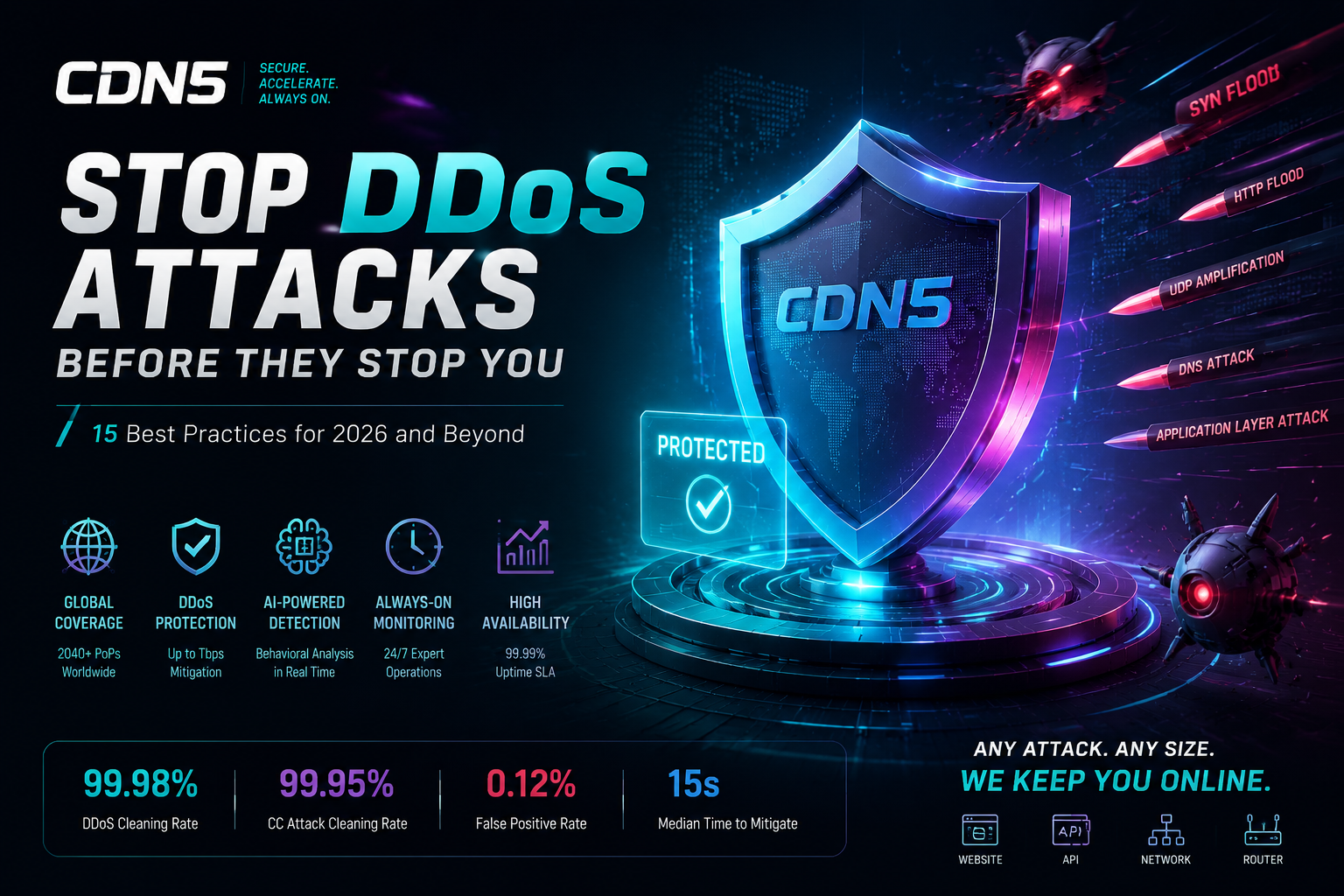
Unmetered mitigation with clean‑traffic billing – CDN5’s Anycast routing breaks terabit‑scale attacks into multiple hundred‑gigabit local flows, absorbing both volumetric and application‑layer attacks at globally distributed edge nodes – no traffic caps, no per‑request charges. Third‑party tests show a 99.98% DDoS scrubbing rate, 99.95% CC attack scrubbing, and a false positive rate of just 0.12%.
24/7 expert monitoring – those 2‑to‑3‑minute short attacks finish before most response teams ever get an alert. CDN5’s security operations team monitors live traffic continuously, validates attack behavior in real time, deploys per‑endpoint controls during an attack, and intervenes as attack tactics shift. Median time from detection to scrubbing is just 15 seconds – most legitimate users never notice anything happened.
High‑availability SLA – CDN5 runs on a global infrastructure with operations centers in Singapore, Hong Kong, Malaysia, the United States, and the UAE – over 2,040 PoPs worldwide, serving more than 30,000 business customers. Distributed architecture and redundancy ensure business continuity.
DDoS attacks change constantly. Botnets are rebuilt, new amplification vectors are discovered, and attack‑as‑a‑service platforms lower the barrier for new threat actors. A DDoS defense that worked six months ago may be full of holes today.
Integrate global threat intelligence feeds – threat intelligence feeds provide known botnet IP ranges, active attack campaigns, and emerging attack techniques. Integrating these into your rate‑limiting and blacklist rules lets you proactively update defenses before known threats are used against you.
Perform post‑mortems after every attack – every DDoS event is a source of data. Document the attack vector, initial indicators of compromise, time from detection to mitigation, and any gaps in response. Use that information to update playbooks, adjust detection thresholds, and refine asset prioritization.
Update behavioral baselines as application traffic patterns change – application traffic patterns evolve with product launches, seasonal changes, and user growth. Behavioral detection baselines calibrated to last year’s traffic patterns will produce false positives on this year’s legitimate spikes. Review and update baselines at least quarterly.
Watch for new amplification vectors – attackers regularly find new protocols that can be used for amplification attacks. Threat intelligence that tracks emerging amplification vectors lets you close related exposures – especially disabling unnecessary services and protocols on network devices before they can be used against your infrastructure.
After reading these 15 practices, you might be asking: where do I start? The answer depends on your environment and where your biggest gaps are.
If you’re protecting websites or web applications – your highest‑priority practices are #4 (reduce website attack surface), #7 (know early warning signs), #9 (behavioral rate limiting per endpoint), and #14 (dedicated DDoS tools with application‑layer detection). Origin IP hiding plus behavioral detection on login and checkout endpoints are the two key controls that close the most common website DDoS gaps.
If you’re protecting network infrastructure – your highest‑priority practices are #5 (reduce network and router attack surface), #6 (surge readiness and upstream scrubbing), #11 (blackhole routing capability), and #14 (traffic scrubbing tools). Router hardening and upstream ISP scrubbing relationships are the two most commonly overlooked controls for network‑level DDoS defense.
If you don’t have dedicated security staff – start with #14. Deploy a managed DDoS protection platform that covers the practices above by default. CDN5 includes behavioral detection, unmetered mitigation, application‑layer protection, bot mitigation, and 24/7 expert monitoring in a single service – and you can get it running in under 30 minutes via CNAME, with no internal team needing to hand‑configure and tune defenses.
Sources cited:
Radware 2026 Global Threat Report – detailed 2026 threat analysis showing sharp increases in DDoS volume and scale.
https://www.globenewswire.com/news-release/2026/02/19/3240861/8980/en/Radware-2026-Global-Threat-Report-Shows-DDoS-Attacks-Jump
Gcore Radar Report: DDoS attacks grew 150% – Q3–Q4 2025 DDoS trend data showing increased volume and complexity.
https://gcore.com/press-releases/gcore-radar-ddos-attack-trends-q3-q4-2025
Cloudflare 2025 Q4 DDoS Threat Report – official Cloudflare threat report covering attack scale and peak bandwidth (e.g., 31.4 Tbps).
https://blog.cloudflare.com/ddos-threat-report-2025-q4/
Cloudflare Radar Quarterly DDoS Report (Q2 2025) – quarterly DDoS data from Cloudflare Radar, useful for long‑term trend comparisons.
https://radar.cloudflare.com/reports/ddos-2025-q2
DDoS Attack Statistics 2026 (Stingrai aggregate) – compilation of the latest statistics from Cloudflare, NETSCOUT, Akamai, and other authoritative sources.
https://www.stingrai.io/blog/ddos-attack-statistics-2026

 Enrique Fay
Aug 06, 2024
 Enrique Fay
May 22, 2025
 Enrique Fay
Aug 11, 2024
 Enrique Fay
Mar 17, 2025
 Enrique Fay
Aug 11, 2024