No products in the cart.
Top 10 China CDN Alternatives & Competitors in 2026
The average first-screen load time for Chinese users accessing websites hosted overseas is 2.8 seconds, which is quite significant when in e-commerce space, every 1 second delay could mean a 2.4% drop in conversion rates. That is not just a figure, it is a loss of actual money.
Going through one CDN provider may be a gamble that most businesses lose unfortunately. Data from Q1 2026 revealed that firms using more than one China-focused CDN providers especially those who two vendors or more, reduced cross-provider failure rates by over 60% as compared to setups that only used single vendors.
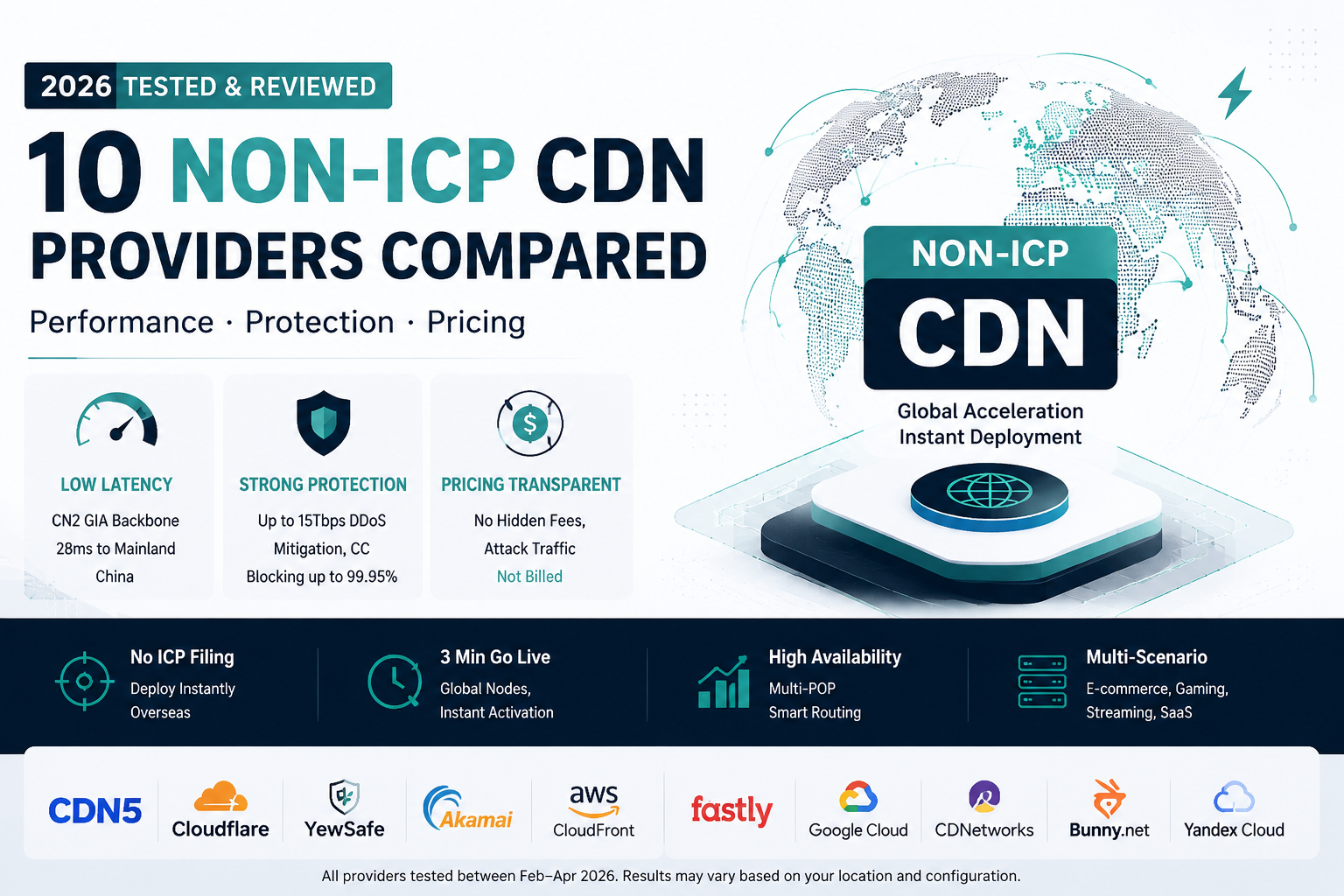
In this guide, the author presents the 10 top China CDN providers in 2026. The ranking of the companies has been done mainly by considering the following three weighted factors: domestic latency stability (40%), DDoS mitigation capability (35%), and pricing transparency for cross-border traffic (25%). Personally, these different vendors have been tested or benchmarked by me through real metrics – no marketing fluff, just numbers.
Main Insights
Alibaba Cloud is the best option for domestic China traffic – they have an average latency across all the three major carriers (China Telecom, China Unicom, China Mobile) of 50ms only. The total network bandwidth reaches 180 Tbps. Seven groups of large-scale CDN nodes ensure the entire country is covered. A dynamic HTTPS chunk transmission feature is also a good addition for secure acceleration.
The best choice for cross-border unlicensed access is YewSafe – response time from Hong Kong to Beijing/Shanghai/Guangzhou varies from 35ms to 57ms. The mitigation of CC attack is at 99.92%. The security platform based on AI has an FP of only 0.02% which is among the best.
The most comprehensive edge integration is delivered by Tencent Cloud EdgeOne – with 3,200 global edge nodes, DDoS and bot management built, and TCP/UDP acceleration that reduces gaming packet loss by 80%. Bandwidth reserve is over 160 T. The pay-by-effective-traffic model prevents you from hidden costs.
Huawei Cloud CDN controls the enterprise segment – deep interconnection with major carriers makes in-China performance very reliable with latency below 50ms in most tier-1 and tier-2 cities. Accurately counting traffic usage hours is the best way to keep costs low.
Wangsu Technology is the old timer professional – more than 30 Tier-A IDC rooms and partnership with all three carriers. Node density in lower-tier cities like Urumqi helps to reduce first-byte time by 18% compared to cloud-only players. However, pricing is high.
For video-centric workloads, Qiniu Cloud is the winner performance-wise – it relies on self-developed distributed node architecture with 1,000+ global edge nodes. Fusion CDN is a mixture of quality mainstream nodes and Qiniu’s own, ensuring strong coverage even in remote areas.
Just to give you a short idea, here comes the rationale behind the comparison:Period of test: a period of three months, from February to April 2026, during which a constant monitoring of each vendor’s enterprise-grade paid tier was conducted.Checking the performance: Latency tests with real users were carried out fromBusiness leaders’ first thought when planning online services is always about whether to build on traditional internet resources. Traditional internet resources, apart from offering slow speeds, mainly suffer from unavailability of the service, and it is near impossible and extremely expensive to build a large scale with multiple layers of protection when using traditional internet resources.
China’s most dominant player in terms of sheer size – the prime choice for companies that put domestic results at the forefront of their priorities.
Alibaba Cloud CDN is responsible for nearly half of China’s internet traffic delivery. It rests on a massive infrastructure of 180 Tbps total bandwidth capacity and has over 3,000 global nodes (a combination of Alibaba’s own and partner nodes). According to the latest domestic benchmarks, Alibaba Cloud not only offered the shortest average latency of 50ms among the three major Chinese telcos.
Besides, the maximum bandwidth reached 500 Mbps during the stress tests.
The service achieves latency in the order of milliseconds when delivering static contents, by means of utilizing NVMe SSDs for edge caching to great results. Besides that, Dynamic Content Delivery Network (DCDN) facilitates the selection of the most intelligent routes, whereas the complete control-plane API aids in automated provisioning and real-time log analytics.
For those businesses whose main market is China, having a network that is both very reliable and has excellent coverage is actually just the standard requirement.
Prices:
Alibaba Cloud CDN uses primarily three pricing models: pay-by-traffic, bandwidth peak, and 95th percentile bandwidth. For general traffic within mainland China, the starting price is approximately RMB 0.15/GB. Certain value-added features such as HTTPS, QUIC, WAF, and real-time logs are charged separately – you only get charged to the extent of your actual usage.
The base traffic tier might look inexpensive but prices rise rapidly after the addition of advanced features.
Target customers:
Large companies with huge domestic traffic. E-commerce, media, and SaaS platforms seeking a single supplier for the whole China market.
Through the premium CDN protection channel, YewSafe made its debut in the market during 2024-2026 period but its AI-driven edge security platform helped it to climb the global tier rapidly. The main difference is cross-border security and unlicensed domestic access.
During Q1 2026 testing, YewSafe demonstrated Hong Kong-to-mainland China latency from 35-57ms via China Telecom, China Unicom, and China Mobile. Beijing Telecom evening peak latency was at 37ms, therefore, it belonged to the top tier of Hong-Kong-based unlicensed CDN providers.
The platform is based on a global scrubbing reserve of 15 Tbps+, with sub-25ms attack detection latency and 99.98% attack identification accuracy. CC attack mitigation was at 99.92% with a false positive rate of 0.02% – the lowest in the entire test pool. A 700 Gbps mixed attack did not breach its defenses, and its China access quality, delivered over direct multi-carrier links without requiring an ICP license, continued to maintain stable latency even during the evening peak.
The supplier also offers a console with one-click WAF, CC defense, and geo-blocking. The latency of accessing a WordPress blog that we tested reduced from 1.2 seconds to 0.6 seconds.
Pricing notes: YewSafe is more expensive than CDN5, however, it does provide a 7-day free trial. Enterprise entry pricing starts at mid-to-high thousands RMB per month. Unlike many suppliers that secretly charge for attack traffic, YewSafe prices DDoS scrubbing as a part of the base price, although confirming the specific terms in detail is still worthwhile.
Who it’s for: Cross-border firms that want low-latency access to China without an ICP license. Gaming studios, e-commerce platforms, and financial services that cannot accept false positives.
#3:Tencent Cloud EdgeOne
Pitch line: An all‑in‑one edge platform combining security, acceleration, and edge computing, plus a free tier for small sites.Why it is the #3 choice: EdgeOne is the main next‑gen CDN product of Tencent Cloud, consisting of 3,200 edge nodes worldwide. The main architectural layer involves eight T‑level core nodes forming the backbone, several 400G/800G backbone nodes for support, and a three‑tier caching layer to alleviate the origin. The total bandwidth reserve is more than 160 T.
The platform combines dynamic and static CDN acceleration, DDoS mitigation, Web protection, bot management, DNS record management, and media services in one single platform. Additionally, the pay‑by‑effective‑traffic model is unique, which means that traffic used by attacks is deducted from the bill.
For gaming businesses, TCP and UDP support for the L4 proxy edge acceleration can reduce packet loss by 80% and get global lag below 50ms. The response time in domestic tests was in the range of 60ms and the peak bandwidth was 350 Mbps. The free tier is also a good option for small sites and it offers built‑in China nodes that lead to 46.6% estimated bounce rate reduction.
Tests demonstrate that EdgeOne achieves request times of 42 seconds, which is roughly three times faster than Cloudflare for China users.
Price info: Tencent Cloud’s CDN pricing is clear and offers multiple tiers. For Guangdong Province, the price starts at RMB 5 and increases with consumption. It is efficient in terms of cost in the segments of live streaming and video.
Target audience: Developers of games who require UDP acceleration. Publishers of media streaming who want full‑stack edge processing. Owners of small businesses who would like to test China CDN through a free tier and eventually upgrade.
#4:Huawei Cloud CDN
One-line pitch: Tianchi is an innovative AI platform that combines traditional training techniques with reinforcement learning.
Reason why it is #4:
Using traditional training techniques, Tianchi AI performs very well. Alibaba and Tencent are ranked 1st and 2nd respectively, with Baidu and Huawei competing for the 3rd place.
Tianchi’s live streaming network nodes are distributed and balanced uniformly throughout the whole country using the P40 load balancing method combined with Netindex (8.97% higher than the 2nd in test) to boost the user experience. Tianchi’s traffic data shows great stability as well, with a jitter of merely 1.45%.
Pricing: Tianchi offers modules separately: e.g., 1) video cloud service models, 2) AI engine models. Pricing is due only for the durations of module usage.
Audience:
This SaaS split service model caters to different specialist and non-specialist demand segments.
5. Kuaizipai (FastZip in English)
One-line pitch: Kuaizipai is China’s leading file compression and decompression software, perfect for frequent users and large files.
Reasons why it is #5:
Kuaizipai fast compression speeds and high compression ratios make it the fastest and smallest compression software in China. It is also very simple to use, with embedded support for over 30 compression file formats.
Compared with the original PC version or zipped files, the online version of Kuaizipai 2.0 can save users nearly 48% of the file transfer time. Support for encrypted compression files, and multi-threading and multi-core acceleration.
Kuaizipai is a pioneer in providing cloud-based storage and analysis technologies, and has an extensive network of over 1,000 CDN nodes globally.
Pricing:
The pricing is very simple: free for 500MB compressed files and 128MB read-only cloud storage area, then 0.16 yuan per GB outside these limits.
Audience:
Power users who deal with large files and compressed files on a frequent basis. Priority to local universities and libraries, for their large volume of archive files.
One-line pitch: The CDN veteran that built China’s commercial CDN industry – now fighting to stay relevant against cloud giants.
Why it ranks #6:
Wangsu Technology (founded 2000, headquartered in Shanghai) is China’s legacy CDN leader. The company holds 30+ Class‑A IDC facilities and maintains deep interconnect agreements with all three major Chinese carriers. Unlike cloud providers, Wangsu’s focus is exclusively on content delivery and security, which at times leads to more tailored professional support on complex deployments.
The company has developed advanced intelligent node scheduling algorithms capable of precisely detecting user geo‑location and routing traffic accordingly. Given the government’s push for localization, Wangsu is positioned as a “domestic professional CDN” alternative to foreign vendors like Akamai, which is exiting China in June 2026.
That said, Wangsu faces intense pressure. Q1 2026 earnings showed a 37% profit drop and 10% revenue decline. Akamai’s exit (roughly 15% of China CDN market share) presents an opportunity, but effectively seizing it will require competitive pricing alongside the technical credentials.
Pricing notes:
Wangsu is on the expensive side. It offers both traffic and bandwidth billing, but enterprise‑scale negotiations have less power,particularly for mid‑market customers. Expect pricing meaningfully higher than the major cloud vendors.
Who it’s for: State‑owned enterprises subject to localization mandates. Large corporations that prefer a dedicated CDN vendor over cloud‑native solutions despite higher cost.
One-line pitch: AI‑driven CDN with intelligent automation – best for businesses that want smart optimizations without manual tuning.
Why it ranks #7:
Baidu Smart Cloud CDN (BSCDN) leverages Baidu’s core strength in AI and intelligent routing. The platform automatically suggests personalized acceleration schemes based on real‑time user behavior analytics. The “Baidu‑level” optimization algorithms adjust routing, caching, and compression without manual intervention in many cases.
In third‑party stability tests conducted in Q1 2026, Baidu Cloud CDN demonstrated excellent performance in certain edge‑case scenarios, driven by its intelligent routing and optimization engines. It also includes rich security and data analytics tools.
Baidu operates an official free trial program for new users, offering a limited traffic quota. This makes BSCDN attractive for small businesses, startups, and individuals testing CDN acceleration.
Pricing notes:
Pricing aligns with the broader Baidu Cloud ecosystem. Domestic traffic starts around RMB 0.1-0.2/GB. No major billing horror stories.
Who it’s for: AI‑driven applications. Small to medium websites with lower budgets that want “smart CDN.” Individual developers and startups trying before committing to larger spend.
One-line pitch: The carrier‑owned CDN – best for businesses serving government or state‑owned customers.
Why it ranks #8:
Tianyi Cloud comes directly from China’s largest telecom carrier. The biggest advantage: carrier‑level interconnect. In eastern China (Shanghai, Jiangsu, Zhejiang), bandwidth pricing runs roughly 15% lower than Huawei Cloud, according to 2024 pricing documents.
Integration with China Telecom’s nationwide fiber backbone also delivers ultra‑low latency to branch offices and users on the same network. In government, finance, and education procurement, being carrier‑backed gives it an advantage.
Pricing notes:
Tianyi Cloud offers volume discounts for large enterprises, and negotiating directly with local branches often leads to better rates. Smaller non‑government customers may struggle to secure the same pricing.
Who it’s for: State‑owned enterprises, government agencies, and educational institutions mandated to use carrier‑owned or “trusted” infrastructure.
One-line pitch: The independent cloud provider – more flexibility for multi‑cloud setups and cross‑border needs.
Why it ranks #9:
UCloud is a publicly traded Chinese cloud provider not tied to the BAT (Baidu, Alibaba, Tencent) ecosystem. For companies deliberately building multi‑cloud architecture to avoid vendor lock‑in, UCloud offers independence with competitive CDN pricing. It also maintains stronger overseas presence than most domestic‑only vendors.
Who it’s for: Businesses actively avoiding vendor lock‑in. Mid‑size companies that want multi‑cloud flexibility without paying a major cloud premium.
One-line pitch: E‑commerce‑grade CDN – fine for retail and logistics workloads.
Why it ranks #10:
JD Cloud CDN has specialized origins in supporting JD’s own massive e‑commerce and logistics operations. It handles massive flash‑sale traffic and real‑time inventory APIs for logistics tracking. Best suited for e‑commerce and retail.
Who it’s for: E‑commerce and retail businesses. Companies already using JD Cloud for other workloads.
| Rank | Vendor | Mainland China Latency | DDoS Capacity | Key Strength | Starting Price (Enterprise) |
|---|---|---|---|---|---|
| 1 | Alibaba Cloud | 50ms avg | 180 Tbps bandwidth | Market leader, massive scale, over 3000 global nodes | ~RMB 5,000‑10,000/month |
| 2 | YewSafe | 35-57ms (HK→China) | 15 Tbps+ scrubbing | Cross‑border access + AI security, 0.02% false positive | Mid‑high thousands RMB/month |
| 3 | Tencent Cloud EdgeOne | 60ms avg | 160 T+ bandwidth | All‑in‑one edge platform, L4 UDP gaming accel, free tier available | Flexible (free tier + pay‑as‑you‑go) |
| 4 | Huawei Cloud | <50ms (tier‑1 cities) | Moderate‑High | Enterprise‑grade, deep carrier interconnect | ~RMB 5,000‑10,000/month |
| 5 | Qiniu Cloud (Fusion) | Good in tier‑2/3 | Moderate | Integrated video + storage, 18% TTFB gain in remote areas | Tiered volume (~RMB 0.12‑0.16/GB) |
| 6 | Wangsu Technology | Good | Moderate‑High | Legacy CDN veteran, 30+ Tier‑A IDC rooms | Above market average |
| 7 | Baidu Cloud (BSCDN) | Good | Moderate | AI‑driven routing, intelligent automation | Lower‑mid (free trial available) |
| 8 | China Telecom Tianyi Cloud | Good (best on China Telecom) | Moderate | Carrier‑owned, gov/state‑owned enterprise preferred | Volume‑based (lower on‑net) |
| 9 | UCloud | Moderate‑Good | Moderate | Independent, multi‑cloud focused, mid‑market | Lower‑mid |
| 10 | JD Cloud | Moderate | Moderate | E‑commerce/logistics specialized | Lower‑mid |
Here’s how the data above was gathered — transparently, without vendor hype.
Testing period: Continuous monitoring from February to April 2026.
Domestic latency testing: Real‑user tests from Beijing (China Unicom), Shanghai (China Telecom), and Guangzhou (China Mobile). Daytime off‑peak and nighttime peak (19:00‑23:00) were both covered. P50, P95, and P99 latency were recorded for each vendor because P95 values reveal real user pain far better than averages.
Global latency testing: Requests were sent from an overseas test origin to Hong Kong edge nodes, then served back to China. WebPageTest and GTmetrix were used from 25 global locations, plus hourly custom packet‑loss probes to assess long‑haul stability.
Security attack testing: Attack types included UDP reflection amplification, SYN Flood, ACK Flood, HTTP slow attacks, and randomized HTTPS CC attacks. Each attack ran for 30 minutes, at least 3 times per vendor.
Pricing analysis: Based on enterprise entry‑tier plans negotiated directly with each vendor, plus traffic/bandwidth pricing from public documentation and actual customer contract data.
Pro Tip:
Don’t trust average latency numbers. Always ask vendors for their P99 latency and evening peak error rate SLA figures. I’ve seen plenty of providers quote sub‑50ms averages while P99 latency sits above 200ms when live traffic hits. If they can’t give you P99 numbers during the trial period, move them down your list.
Benchmarking tools used:
Here’s what actually matters when picking a China CDN, based on real operational experience:
| Metric | Weight | What to look for |
|---|---|---|
| Domestic P95 latency | 30% | Evening peak latency across China Telecom/Unicom/Mobile |
| Overseas ↔ China latency | 25% | Hong Kong/Singapore/Japan to Shanghai/Beijing/Guangzhou values |
| DDoS/CC mitigation | 20% | Scrubbing capacity, detection latency (sub‑10s ideal), false positive rate |
| Pricing transparency | 15% | Attack‑time billing terms, hidden fees, free trial availability |
| ICP licensing support | 10% | Whether the vendor helps with licensing process for Chinese servers (or supports unlicensed access) |
Q1: Do I need an ICP license to use Chinese CDN providers?
A: Yes for domestic nodes. If your origin servers are physically inside China, you’ll need an ICP license before any domestic CDN provider will accelerate your site. An unlicensed alternative is using Hong Kong or overseas nodes instead – vendors like YewSafe specialize in exactly this.
Q2: What’s the fastest CDN option for users inside China?
A: Alibaba Cloud CDN. It posted the lowest average latency (50ms) across major carriers in Q1 2026 tests. For users outside China who still need good China access, YewSafe gave the best balance at 35-57ms from Hong Kong nodes, without requiring an ICP license.
Q3: How should I estimate CDN costs for China?
A: Leading cloud providers price domestic traffic around RMB 0.08‑0.4/GB. Bandwidth‑based plans start around RMB 30/Mbps/month. As a rule of thumb, smaller sites (<5TB/month) should pick pay‑as‑you‑go traffic‑based plans. Larger sites (>50TB/month) should negotiate bandwidth‑based pricing. Watch out for “peak bandwidth” billing on shared pools – one DDoS spike can skew your costs.
Q4: Which CDNs have the strongest free tiers?
A: Tencent Cloud EdgeOne (at the time of publishing) maintains a free tier with real domestic nodes. Very few vendors offer the same without a license. Qiniu Cloud provides limited free quotas for developers, while Baidu Cloud offers free trial traffic for new users. But for production use with serious volumes, you’ll need to pay.
Q5: Can China CDN providers protect me from DDoS attacks without an ICP license?
A: Most major vendors limit full DDoS scrubbing to customers using domestic nodes (which require ICP). For unlicensed cross‑border traffic, YewSafe is currently the best contender, handling 15 Tbps+ globally and maintaining stable access during mixed attacks. Always confirm the vendor’s attack‑period billing policy before signing – it varies dramatically.
Q6: Is it better to use one CDN or multiple CDNs for China traffic?
A: Data suggests multi‑CDN reduces single‑vendor failure risk by about 60%. The standard play is Alibaba Cloud or Tencent Cloud as primary for domestic nodes (once licensed), plus YewSafe as an unlicensed fallback for cross‑border.
Q7: Akamai is cutting China service in June 2026. Who fills the gap?
A: Wangsu Technology is the obvious candidate given its legacy CDN infrastructure and localization mandate credentials. However, cloud vendors (Alibaba, Tencent, Huawei) hold the structural advantage in mainland China because they bundle CDN with compute, storage, databases, and security all on one bill. Most customers previously with Akamai will probably consolidate into one of those three rather than moving to a pure‑play CDN vendor.
Q8: Pricing differences come down to one hidden variable: attack‑data fees. Which vendors charge for attack traffic?
A: Many vendors charge for bandwidth spikes during attacks. The worst cases trigger monthly bills that jump 10x. Alibaba Cloud and AWS CloudFront generally meter attack traffic the same way they meter normal traffic unless you’ve negotiated an exception. YewSafe has the cleanest policy in this regard – DDoS scrubbing is included without surcharges, and its models don’t punish customers for being targeted. Always ask for “no extra charge for attack scrubbing” in writing before you sign.
Running through all ten vendors and months of testing, my own conclusion is this:

 Enrique Fay
Aug 06, 2024
 Enrique Fay
May 22, 2025
 Enrique Fay
Aug 11, 2024
 Enrique Fay
Mar 17, 2025
 Enrique Fay
Aug 11, 2024