No products in the cart.

Learn how a DDoS-protected CDN stops sudden traffic attacks with Anycast routing, traffic scrubbing, bot protection, WAF rules, and origin shielding.
The biggest threat to a website is not “more traffic” by itself.
If a traffic increase comes from genuine business growth, that is good news. More visitors can mean more users, more orders, and more business activity. The real problem begins when the traffic is abnormal. Bandwidth suddenly becomes a bottleneck, connection counts spike to record levels, API responses slow down, and login, payment, or checkout pages can become unreachable within minutes—even though the site was running perfectly just moments earlier.
This kind of situation often happens around online store promotions, game launches, live-streaming events, financial transactions, and SaaS product releases. Attackers rarely choose the quietest hours. Instead, they strike when the business is most exposed, using DDoS attacks, CC attacks, HTTP Floods, bot traffic, and other methods to overwhelm the infrastructure.
This is why more companies are paying close attention to DDoS-protected CDN solutions. A security-focused CDN is no longer just a tool for faster page loading. It is a complete security architecture that combines global edge nodes, traffic routing, DDoS scrubbing, application-layer protection, and origin protection.
So how does a DDoS-protected CDN stop a sudden large-scale traffic attack? How does it separate real users from malicious traffic? What happens first when an attack arrives? And what should enterprises look for when choosing a provider?
This article explains the full process in a practical, real-world way.
When people hear the phrase “large-scale traffic,” many immediately think of a DDoS attack. In real business environments, however, sudden traffic spikes can be either legitimate or malicious. In most cases, they fall into several categories.
For example, an e-commerce business may be running a flash sale, a live stream may be converting large numbers of viewers into buyers, or a game may be launching a new server or event. This kind of traffic may create pressure, but it is still legitimate business activity.
In this case, the business needs elastic scaling, cache optimization, dynamic acceleration, and stable origin access—not aggressive blocking.
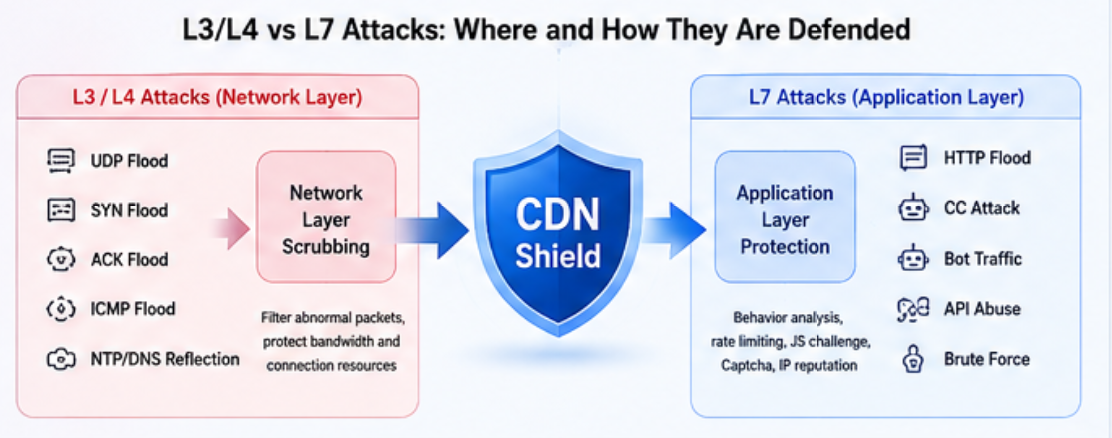
These attacks target the network and transport layers. Common methods include UDP Flood, SYN Flood, ACK Flood, and ICMP Flood. The goal is usually to exhaust bandwidth, fill connection tables, overload firewalls, or effectively close the “front door” of the origin server so normal users cannot establish connections.
This type of attack is more difficult to detect because it can look very similar to legitimate user traffic. The traffic volume does not always need to be extremely high. Attackers may repeatedly hit login, search, payment, query, or API endpoints.
Common examples include HTTP Floods, CC attacks, malicious bots, credential stuffing, and API abuse.
The most difficult attacks today are often not single-vector attacks. Attackers may use UDP Floods to consume bandwidth, CC attacks to slow down application interfaces, and bots to probe the real origin IP at the same time.
At first glance, it may look like a normal traffic surge. In reality, the business may be facing network-layer pressure, application-layer resource exhaustion, and origin-bypass attempts all at once.
For a DDoS-protected CDN, the first step should not be blindly blocking IP addresses or applying rough rate limits. The right first step is to identify the nature of the traffic: a legitimate user surge, malicious attack traffic, or a mixture of both.
Many people think of a CDN as an acceleration tool. It caches images, JavaScript files, static pages, and other assets on edge nodes close to users. This improves user experience and reduces origin load during normal conditions.
But when a large-scale targeted attack occurs, a regular CDN may not be enough.
The key metrics for a regular CDN are usually cache hit ratio and content delivery bandwidth. Its primary job is to deliver content, not to run heavy mitigation hardware for traffic scrubbing and attack handling.
When attack traffic exceeds capacity or targets dynamic interfaces, ordinary CDN nodes can become bottlenecks themselves or fail to protect the origin effectively.
Static content can be cached. Dynamic content, such as login, checkout, payment, and search operations, usually cannot.
Attackers know this. They repeatedly hit dynamic endpoints and turn an ordinary CDN into a relay that forwards malicious traffic directly to the origin.
Modern CC attacks can be highly sophisticated. Attack traffic can imitate real browser fingerprints, valid cookies, normal headers, and legitimate referers.
Because the traffic looks so close to normal user behavior, traditional CDN protection based mainly on IP and QPS rules often fails to distinguish attackers from real users. The result is either weak blocking or overly aggressive blocking that affects legitimate visitors.
Many enterprises assume that using a CDN automatically makes the origin safe. That is not always true.
Attackers may still discover the real origin IP through historical DNS records, mail servers, misconfigured subdomains, certificate transparency logs, or business-level vulnerabilities. Once the CDN is bypassed, all the CDN bandwidth in front of it becomes irrelevant.
This is why DDoS-protected CDNs are not cheap. They are not just “content delivery warehouses.” They are closer to a security escort that identifies, intercepts, scrubs, and only forwards safe traffic to the business system.
A DDoS-protected CDN does not simply react by blocking traffic after an attack starts. It works through a continuous protection process. A mature high-defense CDN usually includes the following stages.
In most cases, edge nodes are the first layer to detect an attack.
A DDoS-protected CDN does not only look at traffic volume. It also analyzes behavior. For example, real users on an e-commerce site usually start from the homepage, browse product pages, and then move toward checkout. Attackers, however, often concentrate on a small number of dynamic URLs. Their user agents may also look unusually similar.
When these abnormal patterns appear, edge nodes trigger alerts and switch into mitigation mode.
The biggest danger of a sudden attack is traffic concentration.
If all attack traffic lands on one node, even a strong protection system can be overwhelmed by a saturated link. That is why DDoS-protected CDNs use Anycast and BGP to distribute traffic across multiple access nodes and scrubbing centers.
In simple terms, Anycast allows multiple access points to share the same service IP. Users and attackers connect to the nearest available route, while the network silently directs traffic to a suitable node. The result is that attack traffic is not forced into a single data center. Instead, it is spread across multiple protection points.
This step is critical. Before malicious traffic can be fully scrubbed, it must first be prevented from saturating the entry link.
Once attack traffic enters the scrubbing center, the network-layer filter handles the most obvious threats first.
This layer is designed to mitigate attacks such as UDP Flood, SYN Flood, ACK Flood, NTP reflection, and DNS reflection. These attacks usually aim to increase traffic volume, flood connection attempts, or exhaust network resources.
Inside the scrubbing center, the DDoS-protected CDN identifies abnormal protocols, terminates malformed connection attempts, restricts forged-source requests, blocks port attacks, and reduces connection rates.
The goal is simple: stop bad traffic before it reaches the business system.
If network-layer attacks are not handled quickly, the WAF, application servers, databases, and load balancers behind the network can also fail. Many websites go down not because the application code is bad, but because the network barrier in front of the business has already been saturated.
After network-layer threats are filtered, much of the remaining traffic may consist of CC attacks and HTTP Floods. This traffic can look extremely similar to normal user behavior, which is why simple rules often fail.
At this stage, a DDoS-protected CDN acts like a high-precision microscope. It examines many signals, including:
The key is not to block aggressively, but to block accurately. The system must reject malicious automation without turning away legitimate users. A crude “deny everyone” strategy is not real protection.
Many companies connect a strong DDoS-protected CDN but forget to secure the origin server. If the origin remains publicly accessible on the internet, attackers can still hit it directly once they discover the origin IP.
A mature solution closes the loop. The origin IP is hidden, origin pull is restricted through whitelisting, fixed egress IPs or private lines may be used, and the origin server only accepts traffic from approved CDN nodes. All other public traffic should be rejected.
Attackers usually do not continue forever. Once an attack fails to achieve its goal or becomes too expensive, they often stop.
After the attack traffic drops, the DDoS-protected CDN should reduce its defense level quickly and smoothly. If the attack is over but the system stays in emergency mode, users may still face unnecessary verification, slower responses, and a worse experience.
A mature platform can shift from scrubbing-first mode back to acceleration-first mode and downgrade high-level anti-CC rules to normal monitoring. This helps restore user experience with minimal disruption.
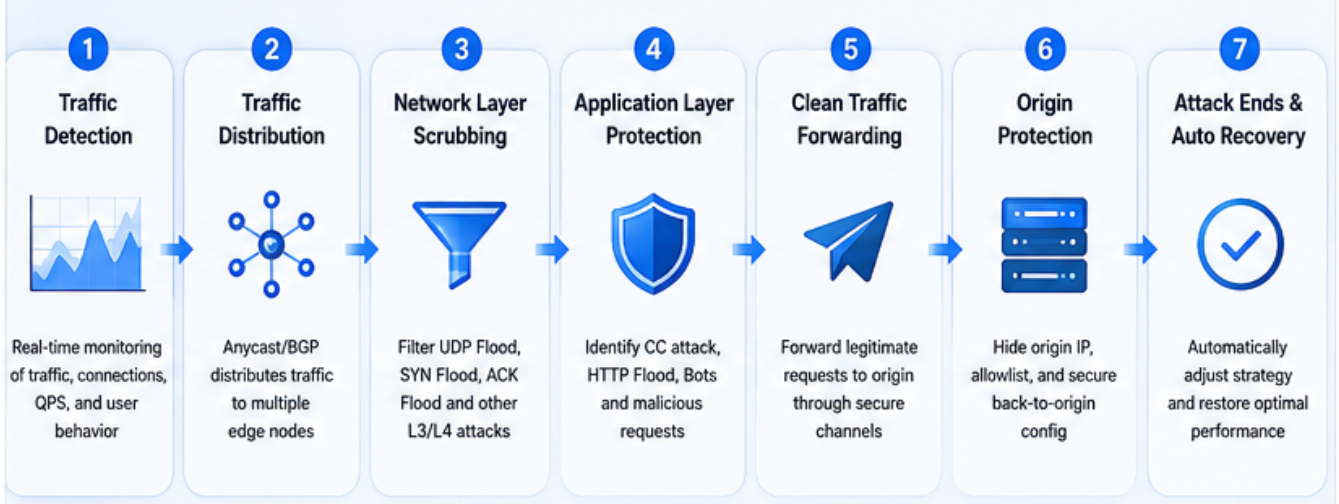
| Stage | What the DDoS-Protected CDN Does | Core Objective |
|---|---|---|
| Traffic anomaly appears | Edge nodes monitor QPS, bandwidth, connection counts, access paths, and request behavior | Detect whether attack signals exist |
| Attack traffic enters | Anycast/BGP distributes traffic across multiple edge nodes or scrubbing centers | Prevent a single entry link from being saturated |
| Network-layer scrubbing | Filters UDP Flood, SYN Flood, ACK Flood, and similar attacks | Protect bandwidth and connection resources |
| Application-layer identification | Analyzes HTTP requests, bot behavior, cookies, headers, and API access frequency | Block CC attacks and malicious requests |
| Legitimate requests pass through | Real user requests reach the origin through a secure path | Maintain business continuity |
| Origin protection | Uses origin-pull whitelisting, origin IP hiding, and direct-access restrictions | Prevent attackers from bypassing the CDN |
| Post-attack recovery | Automatically adjusts protection policies and switches back to the optimal path | Restore performance and generate attack reports |
As the table shows, a DDoS-protected CDN does much more than “block an attack.” It helps keep the business running throughout the entire attack lifecycle: before, during, and after the incident.
Let’s look at a typical example: a cross-border e-commerce site running a Black Friday campaign.
Under normal conditions, the site handles about 30,000 QPS. Once the sale begins, legitimate user traffic rises to 80,000 QPS. That increase is expected.
But ten minutes after launch, the monitoring system suddenly reports that QPS has jumped to 500,000 with no warning.
A deeper investigation shows that attackers are not targeting static images. Instead, they are hammering login, search, and coupon APIs. At the same time, UDP Flood traffic is pushing data center bandwidth toward its limit. Users begin reporting slow page loads, payment failures, and frequent request timeouts.
Without serious protection, or with only basic protection in place, the situation can quickly become a nightmare:
The business goes down, and the promotion is ruined.
With a mature DDoS-protected CDN in place, the outcome is very different.
During the attack, edge nodes are usually the first to trigger threat alerts. The intelligent routing system reacts within seconds and distributes the 500,000 QPS flood across global scrubbing centers. Attack traffic is not allowed to overload a single entry point.
After traffic reaches the scrubbing centers, it first passes through network-layer filtering. At the hardware level, large UDP and SYN packets designed to saturate bandwidth are dropped.
Then the application layer takes over. Within the 500,000 QPS traffic flow, the system identifies who is who. It examines access frequency, cookie status, header behavior, and abnormal request patterns. Suspicious traffic is blocked or challenged with JS verification, while genuine customers are allowed through within seconds.
Clean, legitimate user requests are routed to the real server through a private line or secure origin whitelist. Because the origin IP is fully protected behind the CDN, attackers have a much harder time discovering and hitting it directly.
Once attackers realize their attempts are not working, they usually stop. The protection system then automatically lowers the defense level and switches the access path back to its fastest normal state.
The operations team does not need to reboot servers or clean up a disaster. Instead, they review the automatically generated attack report, which may show how much traffic was blocked, how many malicious IPs were filtered, whether legitimate users were affected, and which APIs were targeted.
Detection within seconds → traffic distribution → intelligent scrubbing → strict separation → origin hiding → smooth business recovery. This is the complete response flow of a mature DDoS-protected CDN.
Business owners and product managers often ask: “Can’t a regular CDN already handle multi-gigabit traffic? Isn’t it distributed too? Why pay extra for a high-defense CDN?”
The truth is that these two products are designed for different purposes.
A regular CDN is like a sports car built for speed. A DDoS-protected CDN is more like an armored vehicle that keeps moving even under fire.
| Core Comparison | Ordinary CDN | DDoS-Protected CDN |
|---|---|---|
| Core objective | Caches static resources such as images and videos at the edge to make access faster. | Accelerates content while resisting attacks and keeping the origin online. |
| DDoS and large-traffic resistance | Node bandwidth is relatively fragile. During a large attack, the service may degrade or the domain may trigger blackhole protection policies. | Uses Tbps-level scrubbing centers and Anycast routing architecture designed specifically for large-scale attack traffic. |
| Dynamic API CC/Bot protection | Has limited application-layer identification. Malicious traffic targeting login, payment, or API endpoints may be forwarded to the origin. | Includes WAF, bot behavior analysis, and API-level rate limiting to separate malicious scripts from real users. |
| Origin hiding | Mostly works as a proxy. If historical DNS records or subdomains are exposed, attackers may still discover the origin IP. | Provides deeper origin protection through fixed origin-pull IP ranges, secure origin access, and strict whitelist policies. |
| User experience under extreme conditions | Once attacked, the site may become unavailable, slow, or filled with errors. | Prioritizes business continuity and aims to keep P95/P99 latency under control while legitimate users continue to access key services. |
| Best-fit scenarios | Basic corporate websites, image sites, download sites, and mostly static content delivery. | Core business scenarios involving transactions, logins, API calls, game connections, live interactions, and financial payments. |
If your website is a simple static corporate site used mainly for announcements, an ordinary CDN may be enough.
But if your business involves payments, logins, API calls, gaming, or intense competition, a DDoS-protected CDN becomes essential. In many cases, the revenue lost from just one hour of downtime can easily cover years of protection costs.
Choosing a DDoS-protected CDN based only on marketing claims is risky. Provider websites may show impressive numbers, but the real difference only appears after deployment. Enterprises should evaluate the following areas carefully.
Many providers claim they can defend a single site against a certain number of gigabits or terabits. But attack traffic is distributed and can come from many regions at once.
If a provider’s scrubbing resources are limited to a few major data centers, local failures can still happen when attack traffic originates from areas without proper scrubbing nodes or when cross-region routing overloads a single path.
A strong high-defense infrastructure needs network-wide coordination. It should have distributed scrubbing centers and the ability to use Anycast or intelligent DNS to split attack traffic across global scrubbing points as soon as an attack begins.
A provider may have many nodes, but if traffic must be rerouted to a distant data center whenever scrubbing is enabled, the result can feel almost the same as downtime.
This is especially important for e-commerce, gaming, and SaaS API businesses, where latency directly affects user experience and revenue.
During attacks, enterprises should look beyond average latency and pay attention to P95 and P99 latency. Average latency can be misleading. A spike in P99 latency means a meaningful portion of users are already experiencing lag or timeouts.
An effective DDoS-protected CDN should block attack traffic while still allowing legitimate users to pass through nearby edge nodes with minimal disruption, especially for login, checkout, payment, and other critical workflows.
Attackers have become smarter. They know static resources are cached and pure bandwidth attacks can be expensive. So they target weak points instead.
They may use large proxy IP pools to abuse CAPTCHA, product search, SMS, payment, or database query APIs. This type of attack may not require much bandwidth, but it can push application servers and databases to 100% CPU within seconds.
If a DDoS-protected CDN talks only about DDoS mitigation and ignores application-layer protection, that is a warning sign. Enterprises should check how well it detects advanced CC attacks and malicious bots, including JS challenges, cookie checks, API-level rate limits, and dynamic signature filtering.
Some firewall rules are extremely aggressive. They may stop the attack, but they also block real users. That kind of defense is not useful.
This is especially true during game launches, e-commerce promotions, and flash sales, where legitimate user behavior can look very similar to CC traffic. At that moment, the quality of the CDN’s detection algorithm becomes critical.
Enterprises should ask providers clear questions: What is your false positive rate? What percentage of real users can pass through? Can protection policies be customized for specific APIs?
The rule is simple: block malicious traffic without interfering with real users.
Even if the CDN edge works well, everything can fail if attackers can bypass it and hit the origin IP directly.
Attackers may use historical DNS records, subdomain scans, certificate transparency logs, and other methods to find the real origin. That is why origin protection must be part of the evaluation.
For example, does the provider support closed-loop origin whitelisting, origin-pull IP range rotation, secure origin access through private lines, or high-defense IPs?
A DDoS-protected CDN is not only about stopping traffic at the edge. It should also ensure the origin IP is not publicly exposed and cannot be reached directly from the internet.
After an incident, enterprises should not be satisfied with a vague statement such as “We stopped a 100G attack.”
They need details.
A strong CDN solution should provide detailed logs and reports, including when the attack occurred, what type of attack it was, whether it involved SYN, UDP, or HTTP Flood traffic, where the attack traffic came from, which security rules were triggered, and whether origin access remained normal.
This information allows operations teams to improve future defense policies instead of being caught off guard again.
For a DDoS-protected CDN, the real challenge is not simply “blocking a wave of traffic.” It must achieve several goals at the same time:
Using YewSafe DDoS-Protected CDN as an example, the key capabilities include edge absorption, smart routing, multi-layer scrubbing, and secure origin access.
As the first step in handling attack traffic, YewSafe processes incoming requests through more than 4,000 global edge nodes. It combines Anycast with intelligent BGP routing so abnormal traffic can be redirected to scrubbing centers without overloading a single link.
When L3/L4 attacks such as UDP Flood, SYN Flood, and ACK Flood occur, YewSafe filters them at the network layer through scrubbing centers.
This protects bandwidth, connection capacity, and origin entry resources while preventing malicious traffic from entering the business network. It also reduces cascading pressure on the origin, firewall, load balancer, and database.
For more hidden attacks such as CC attacks, HTTP Floods, malicious bots, and application-layer traffic that imitates real users, YewSafe uses its Sentinel / YewGuardian edge scrubbing system for behavior-based detection.
The system goes beyond blocking IP addresses. It examines request frequency, access paths, header characteristics, cookie status, JS challenge results, API request rhythm, IP reputation, and other signals.
This is especially important for e-commerce, finance, gaming, and SaaS API businesses, where high request volume from real users is normal during peak periods.
In these scenarios, rules that are too aggressive may block legitimate users, while rules that are too loose may allow attack traffic to reach the origin.
YewSafe also provides multiple ways to mask the origin IP, including edge whitelist origin pull and egress IP rotation.
Beyond static caching, secure origin access is essential for dynamic business systems such as login, payment, order, query, game gateway, and API services.
Across the full traffic path, YewSafe does not rely on a single capability.
It receives incoming traffic through edge nodes, distributes attack pressure across 35 scrubbing centers, and provides overall defense capacity for 350Tbps+ DDoS attacks.
It keeps access paths stable through intelligent routing and combines application-layer defense with secure origin access to protect critical business systems.
In short, YewSafe is designed to protect business continuity during attacks—not just to show that traffic was blocked.
To be direct, if your website is only a static corporate site displaying product slides, you probably do not need to invest heavily in this.
But if your business falls into any of the following categories, relying on luck is not a strategy. A DDoS-protected CDN becomes a practical choice.
Attackers know exactly when to strike. They target the first minutes of a flash sale, the peak of influencer-driven traffic, or the busiest payment window.
In this scenario, login, inventory lookup, and coupon APIs are common targets.
Even a one-second delay can cost orders and reduce conversion rates. For cross-border e-commerce, the two key priorities are dynamic API protection and bot identification.
The payment callback path must remain secure and available.
Attacks are very common in the gaming industry.
New server launches, major version updates, and tournaments can cause real players and attack traffic to surge at the same time.
Attackers may use DDoS attacks to disrupt game servers or use CC attacks and credential stuffing to degrade login services.
For gaming, survival depends on low latency and low false positives.
A protection system cannot block legitimate players just because they use accelerators. Even a few hundred milliseconds of extra lag can be enough to make players quit.
A financial platform does not need to go fully offline to suffer damage.
Attackers only need to slow down transaction APIs, cause risk-control interfaces to time out, or make payment requests fail intermittently. That alone can trigger complaints, panic, and loss of trust.
For this type of business, the requirement goes far beyond simple attack resistance.
API-level protection, origin hiding, audit logs, and compliance readiness are all critical.
SaaS platforms can be deceptive. They may look like websites, but they are often powered almost entirely by APIs.
Attackers tend to focus on data query, upload, and callback endpoints.
If APIs become unavailable even briefly, hundreds or thousands of enterprise customers may be affected, leading to compensation costs and loss of trust.
These platforms require precise API-level rate limiting and abnormal behavior detection.
Live-streaming traffic is highly spiky and unpredictable.
Before a broadcast starts, the room may be quiet. The moment the host goes live, tens or hundreds of thousands of viewers may enter almost at once.
This kind of traffic surge is often mixed with malicious network-layer packets, fake comments, fake gifts, and CC attacks.
A DDoS-protected CDN needs to handle video delivery load while also protecting interaction, authentication, and payment paths.
Protecting only static resources is not enough.
Many people assume that once they buy a DDoS-protected CDN, the problem is solved.
But security is a system. If the origin is still exposed, even the best CDN edge protection cannot fully protect the business.
Operations teams should make sure the following tasks are completed.
After connecting to the CDN, the origin server should not remain publicly exposed.
Firewall rules or security groups should allow access only from CDN origin-pull IP ranges. All other public requests should be dropped.
Attackers do not always look for the real IP from the front door.
They may search historical DNS records, expired test domains, old subdomains, mail server records, and other traces.
If the origin IP has ever been exposed, attackers may bypass the CDN and attack it directly. Before going live, enterprises should clean up these records and reset the origin IP if necessary.
Login, registration, SMS, payment, and search APIs behave very differently from static pages.
Applying one uniform rate-limiting rule to every endpoint is not appropriate.
Protection and validation policies should be granular enough for different business interfaces.
Attacks can happen late at night or during peak business hours. Enterprises should define responsibilities in advance.
For example, who communicates with the CDN provider? Who monitors origin CPU and system load? Who adjusts security rules? Who handles customer communication?
Do not wait until an attack starts to figure this out.
Teams should review attack sources, attack methods, triggered rules, false positives, API load, and origin status. This makes future defense more accurate.
Sudden large-scale traffic attacks are dangerous not only because of their size, but also because of their speed, variability, and impact across multiple business components.
Some attacks consume bandwidth. Some exhaust connection resources. Others target dynamic APIs. Some try to bypass the CDN and attack the origin directly.
If an enterprise relies only on an ordinary CDN, a single high-defense IP, or temporary IP-blocking rules, it is unlikely to stay stable against complex attack patterns.
The value of a DDoS-protected CDN is that it moves protection closer to the edge.
It receives entrance traffic through global nodes, redistributes attack pressure with Anycast and BGP, uses scrubbing centers to filter large-scale attacks, applies application-layer rules to identify CC and bot traffic, and keeps the origin accessible only through secure origin access controls.
For enterprises, choosing a DDoS-protected CDN is not just about buying a large “defense number.” What matters is whether the site stays accessible, APIs remain responsive, orders can still be placed, games can still be logged into, and customers can continue using the service during an attack.
That is the real purpose of a DDoS-protected CDN: protecting business continuity when sudden large-scale traffic attacks hit.
An ordinary CDN mainly focuses on acceleration, while security is often secondary or added as an extra feature. A DDoS-protected CDN treats security as a core capability from the design stage. It combines traffic scrubbing, attack detection, origin hiding, and other protection mechanisms at the edge.
A robust DDoS-protected CDN keeps additional latency minimal through broad global node coverage, Anycast-based routing to nearby nodes, and hardware acceleration.
For example, during a 1.2Tbps attack, YewSafe can keep additional latency below 2 milliseconds.
A DDoS attack usually targets the network or transport layer and tries to disrupt service by flooding bandwidth with large amounts of traffic.
A CC attack targets the application layer. It sends high-frequency requests that look legitimate in order to exhaust server resources.
In many real-world attacks, both appear together and work in combination.
That depends on the provider’s total network defense capacity.
Top providers generally offer hundreds of Tbps of network-wide defense capacity.
When choosing a provider, enterprises should evaluate the total network-wide defense capacity, not just the peak value of a single node.
Yes.
The purpose of a DDoS-protected CDN is to allow genuine users to stay connected during an attack.
Through multi-layer scrubbing and precise identification, malicious traffic is usually blocked at the edge, while legitimate user requests continue to reach the origin normally.
Evaluate the provider across six areas: total defense capacity, scrubbing center distribution, routing speed, CC detection rate and false positive rate, origin hiding capability, and detailed attack reporting.
Do not judge a provider only by its advertised peak defense number.

 Enrique Fay
Aug 06, 2024
 Enrique Fay
May 22, 2025
 Enrique Fay
Aug 11, 2024
 Enrique Fay
Mar 17, 2025
 Enrique Fay
Aug 11, 2024